1 Ton Lifting Magnet Factory: RFQ Checklist & Triage Tool
Build a supplier RFQ, pilot, or hold path from your load and sourcing profile, then verify model-specific evidence, operating limits, and risk controls before any purchase decision.
Tool Layer
1 Ton Factory RFQ Triage
Turn your load and sourcing profile into a supplier evidence path. This does not select or certify a magnet.
Start with the producer behind the quote
A capacity label and a sales channel do not tell you which site built the magnet or whether its records match your load. Use these checks to make factory offers comparable.
Identify who will build the quoted model
Record the contracting seller and the actual production site. If assembly or testing is subcontracted, ask which company owns each step.
A “factory” label does not identify the legal manufacturer or the site that made the quoted configuration.
Match every record to a model and revision
Keep the model code, drawing revision, nameplate, and test file together so supplier documents describe the same unit.
A quality-system certificate describes a management system; it does not establish a particular magnet’s rated performance.
Send the load profile before asking for a rating
Include material, geometry, contact surface, orientation, temperature, and duty. Ask the manufacturer to respond against those conditions.
HSE supplier guidance calls for enough information about the intended load and application before equipment is recommended.
Set sample acceptance before volume terms
Agree how a representative sample will be checked, who witnesses it, and what happens if the evidence or sample does not match.
The RFQ, pilot, and hold outputs are procurement paths only; they do not approve a lift.
LiftMagnetics works through manufacturing partners
LiftMagnetics describes its supply model as factory-direct through dedicated manufacturing partnerships in China. Its public company profile reports 50+ production staff, 60+ precision machines, and a 3-day raw-material sourcing cycle across those facilities.
These are company-reported figures, not an independent site audit or model-specific lifting test. Ask which partner site will make your quoted model and request the records listed below.
See the company profile and production details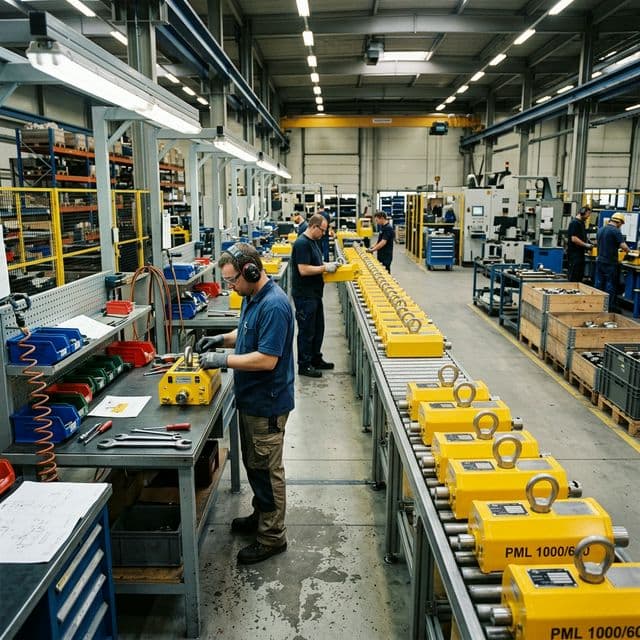
Already comparing a factory quote?
Share the quoted model, production-site identity, and the load profile you entered. Engineering can help identify what still needs confirmation.
Factory evidence: identify who builds the quoted model
Request a traceable chain from legal manufacturer and production site to model revision, test record, and delivered serial. This checklist is a buyer worksheet, not an independent factory audit.
| Factory check | Ask the supplier for | Verify before shortlist or pilot |
|---|---|---|
| Manufacturer and production site | Legal manufacturer name, factory address, production scope, and any outsourced assembly or testing steps. | Match the named entities across the quote, drawings, product label, and test records. Ask for a site or independent audit when needed. |
| Model identity and revision | Exact model code, current drawing/revision, rated configuration, serial or batch format, and change-notification process. | Confirm the sample, nameplate, technical file, and commercial offer all refer to the same revision. |
| Application-matched performance evidence | Rated-capacity data and test conditions for the stated load material, shape, dimensions, contact surface, temperature, and orientation. | Check that the published rating covers your application. Ask who performed the test and request a traceable report for the quoted model. |
| Production and final inspection records | A sample inspection/test record, equipment identification, calibration traceability where relevant, and handling of nonconforming units. | Follow one sample or serial number from the production record to its inspection result and shipment documentation. |
| Quality-system scope | Current certificate, issuing body, covered legal entity/site, scope, and expiry; ask what controls apply to the lifting-magnet line. | Confirm the certificate belongs to the actual producing site. Treat it as process evidence, not proof of magnet capacity. |
| Sample, acceptance, and after-sales plan | Written sample criteria, inspection responsibilities, defect remedy, spare-parts contact, and serial/lot traceability after delivery. | Agree pass/fail conditions and escalation steps before placing a volume order. |
Factory-direct and reseller offers: compare the evidence chain
A sales channel is not a quality rating. Compare who contracts, who builds, who tests, and who supports the magnet after delivery.
Direct factory quotation
Verify: Confirm the quoting legal entity and actual build/test site, then link its records to the exact model and revision.
Watch for: A direct sales contact alone does not prove that the named factory produced or tested the quoted unit.
Trading company or marketplace offer
Verify: Ask for the legal manufacturer, production address, authorization where relevant, and a direct chain from product serial to test evidence.
Watch for: The seller and manufacturer may be different entities, so documents can describe another product or site.
Factory plus local importer/service partner
Verify: Assign who handles conformity documents, installation support, warranty claims, inspections, and replacement parts in the destination market.
Watch for: A capable factory may still leave a gap in local service or documentation ownership.
Use one qualification sequence for every factory
Keep the candidate comparison fair by sending the same load profile, evidence request, and sample criteria to each supplier.
1. Define one representative load
Describe the heaviest and least favorable intended load, including material, dimensions, surface, temperature, orientation, and lift frequency.
Move forward when: A written application profile that every candidate factory receives unchanged.
2. Request comparable factory records
Send the same RFQ fields and evidence checklist to each candidate. Record missing answers instead of filling gaps with assumptions.
Move forward when: Model-linked documents with producer, revision, conditions, and test method identified.
3. Review a sample or controlled pilot
Agree a competent test plan, acceptance criteria, witness, and stop rule before any representative lift or volume order.
Move forward when: Signed sample findings tied to the tested serial/model and stated operating conditions.
4. Close the production and service handoff
Set production-change notice, lot/serial traceability, delivery inspection, support contact, and remedy terms in writing.
Move forward when: A purchasing file that connects the accepted sample to the units and support route being ordered.
RFQ fields to send with a 1-ton requirement
Complete these fields before comparing factory quotations. The tool above carries the operating profile into an RFQ, pilot, or hold path; the supplier must confirm model suitability in writing.
| RFQ section | Include these details |
|---|---|
| Load and material | Mass range, dimensions, steel grade or material record, plate/round/irregular shape, and representative drawings or photos. |
| Contact and lift | Scale/coating/oil condition, air-gap concerns, horizontal/vertical/tilted orientation, attachment method, and crane interface. |
| Temperature and duty | Maximum load temperature, lifts per hour, shift duration, indoor/outdoor exposure, and any hot-work adjacency. |
| Factory evidence | Legal manufacturer and site, exact model/revision, rated data, test conditions, sample inspection record, and traceability method. |
| Procurement and destination | Quantity, requested lead time, delivery location, destination-market documentation, sample acceptance criteria, warranty, and service contact. |
Destination-market marking, inspection, and operating duties vary by jurisdiction and product configuration. Confirm them with the responsible importer, competent engineer, or regulator.
Questions buyers ask before choosing a factory
Answers focus on verifying the producer, its records, and the proposed acceptance path.
Qualifying the factory
What should I ask a 1 ton lifting magnet factory for first?
Start with the legal manufacturer and production-site identity, then request model- and revision-specific rated data with the load conditions and test method stated. Add sample inspection, traceability, and service records before comparing volume terms.
Does an ISO 9001 certificate prove the magnet can lift my load?
No. It is evidence about a quality-management system within its stated scope. It does not prove a particular model’s performance for your geometry, surface, temperature, or duty. Request model-linked evidence and have a competent person assess the actual operation.
Is a factory-direct offer safer than a marketplace offer?
The sales channel alone does not establish product quality. Verify who manufactures the quoted model, where it is built and tested, and whether the records match the offered revision. Include the local importer or service partner when one is part of the supply chain.
What should a sample or pilot confirm?
Agree the representative load and acceptance criteria in advance. The test plan should cover the intended material, geometry, contact condition, orientation, temperature, interfaces, and operating controls, under competent engineering oversight.
What if the supplier cannot provide model-specific test records?
Keep the decision on hold or request a controlled sample plan with explicit evidence and acceptance requirements. Do not infer capacity from a product family name, general certificate, or another model’s report.
Next step: have the quoted model reviewed
Send the load profile, supplier identity, and model-linked documents together. A review can identify questions that remain before a sample, pilot, or volume order.
Include with your inquiry
- - Load drawing, material, mass range, and contact surface.
- - Orientation, temperature, and lift frequency.
- - Quoted factory, model code, and drawing revision.
- - Test records, sample criteria, quantity, and timeline.