2 Ton Magnetic Lifter Supplier: Selector + Supplier Evidence Gate
Built for 2 ton magnetic lifter supplier decisions while also covering magnetic lifter 2 ton, 2 ton lifting magnet supplier, manufacturer, pricelist, for-sale, and China-intent decisions in one canonical workflow.
Use this canonical URL to run the selector first, then verify evidence and risk controls before RFQ or pilot release. Intent variants (including 2 ton magnetic lifter supplier, 2 ton magnetic lifter manufacturer, and 2 ton magnetic lifter china) map to the same tool-and-report flow to avoid duplicate routes and split decisions.
Tool Layer
2 Ton Magnetic Lifter Selector
Start from a 2 metric-tonne baseline, then normalize the unit basis and boundary factors before requesting models or releasing a pilot.
Alias Intent Merge: Supplier + Manufacturer + Pricelist + For-Sale
This page keeps one canonical URL for the same buying intent cluster (including China variants) so users can run the tool and complete evidence review without route splitting.
Canonical mapping table
| Query phrase | Canonical URL | Route action | Reason |
|---|---|---|---|
| 2 ton magnetic lifter | /learn/magnetic-lifter-2-ton | alias_merge (no dedicated page) | Same ambiguous do+know intent as magnetic lifter 2 ton: users need immediate class-fit output plus evidence and risk review, so one canonical hybrid URL is retained. |
| 2 ton lifting magnet | /learn/magnetic-lifter-2-ton | alias_merge (no dedicated page) | Same do+know decision lane as magnetic lifter 2 ton; one canonical route preserves tool and evidence continuity. |
| 2 ton magnetic lifter china | /learn/magnetic-lifter-2-ton | alias_merge (no dedicated page) | China-intent still needs the same class-fit tool output, sourcing evidence checks, and boundary warnings, so one canonical hybrid lane is retained. |
| 2 ton magnetic lifter supplier | /learn/magnetic-lifter-2-ton | alias_merge (no dedicated page) | Same supplier-intent cluster as magnetic lifter 2 ton: users need class-fit output, quote normalization, supplier evidence checks, and risk boundaries in one canonical hybrid URL. |
| 2 ton lifting magnet supplier | /learn/magnetic-lifter-2-ton | alias_merge (no dedicated page) | Supplier-intent asks for immediate sizing plus sourcing proof checks, so one canonical tool + report route is retained. |
| 2 ton magnetic lifter manufacturer | /learn/magnetic-lifter-2-ton | alias_merge (no dedicated page) | Manufacturer search results resolve to the same 2-ton class-fit, proof-evidence, and RFQ-readiness decision as magnetic lifter 2 ton, so no separate route is created. |
| 2 ton lifting magnet manufacturer | /learn/magnetic-lifter-2-ton | alias_merge (no dedicated page) | Manufacturer-intent overlaps with magnetic lifter 2 ton selection and qualification intent; keep one canonical URL. |
| 2 ton lifting magnet pricelist | /learn/magnetic-lifter-2-ton | alias_merge (no dedicated page) | Pricelist-intent still depends on class fit and evidence quality; use one canonical tool + report lane instead of a duplicate price-only page. |
| 2 ton lifting magnet for sale | /learn/magnetic-lifter-2-ton | alias_merge (no dedicated page) | Same do+know intent cluster as magnetic lifter 2 ton; avoid duplicate routes. |
What users get here
- - Immediate selector output for class fit, confidence, and next action.
- - Evidence-backed report layer for sourcing, compliance, and operational risk tradeoffs.
- - Same canonical action path for 2 ton magnetic lifter, 2 ton lifting magnet, 2 ton magnetic lifter supplier, 2 ton lifting magnet supplier, 2 ton magnetic lifter manufacturer, 2 ton lifting magnet manufacturer, 2 ton lifting magnet pricelist, 2 ton lifting magnet for sale and magnetic lifter 2 ton queries.
2 Ton Magnetic Lifter Supplier Qualification Gate
Supplier intent is broader than manufacturer intent. A 2 ton magnetic lifter supplier may be the OEM, distributor, importer, stockist, private-label packager, or China export seller. Updated June 9, 2026 from HSE, OSHA, ISO/IAF, EU, GOV.UK, SAMR, and supplier-catalog source checks.
First supplier question
Who owns proof?
Capacity, test, conformity, inspection, and import evidence must have named owners.
Common false positive
Stock available
Availability does not prove serial identity, test record, manual, market route, or prior-use condition.
Evidence status
Role-dependent
Treat missing role ownership as pending confirmation, not a harmless quote detail.
Supplier role and evidence matrix
| Supplier role | Verified fact | Decision risk | Minimum evidence | Source |
|---|---|---|---|---|
| OEM selling direct | The supplier can be the manufacturer, but supplier status still needs QMS validation, model-specific test records, instructions, and destination-market conformity ownership. | A direct factory quote can look complete while the 2-ton model file, operating boundary, and release-test evidence remain generic or stale. | Ask for certificate validation record, quoted-model serial/test basis, manual, marking photo, conformity route, and named document owner with revision dates. | ISO 9001 + EU technical documentation |
| Distributor or importer | GOV.UK guidance says importers/distributors can take manufacturer responsibilities if they place products under their own name or modify compliance-relevant design. | The buyer may assume the overseas manufacturer owns the file while the local supplier has changed branding, instructions, accessories, or market-placement route. | Lock GB/EU/NI market route, importer/manufacturer role, technical-document retention owner, labeling path, and change-control responsibility before PO release. | GOV.UK UKCA/CE market placement guidance |
| Stockist or used-equipment seller | OSHA 1910.179 requires rated-load test reports to be available to appointed personnel, and HSE/LOLER routes require documented examination and safe-use controls. | Inventory availability can hide missing test reports, unknown prior overload, lost manuals, expired examination status, or accessory mismatch. | Require current condition report, rated-load/proof-test record, serial identity, latest thorough-exam or inspection evidence, manual, and accessory compatibility record. | OSHA 1910.179 + HSE LOLER overview |
| Private-label or modified package | EU/GB guidance treats technical documentation as the basis for conformity; product changes, own-brand placement, or altered accessories can shift responsibility. | A valid original manufacturer file may not cover the supplied package if the supplier changes labels, hooks, release controls, manuals, or accessories. | Request a delta file showing what changed, who approved it, which standards and tests still apply, and who signs the conformity statement for the delivered package. | Your Europe + GOV.UK role guidance |
| China export supplier | China-route evidence needs both product/supplier proof and route proof: import documents, Chinese labels/instructions where required, and supervision-inspection responsibility for covered equipment. | A low quote or capacity certificate can pass desktop sourcing while legal-entry, inspection, or document-language duties are still unassigned. | Assign Article 25/30/31 evidence owner, export/import document pack, Chinese-language documentation status, inspection scope, and commissioning release record. | SAMR Special Equipment Safety Law |
2 Ton Magnetic Lifter Manufacturer Qualification Gate
Manufacturer intent is not just “find a factory.” It is a release question: can this specific manufacturer prove quality-system scope, product test evidence, technical-document ownership, and destination-market readiness for the 2-ton model being quoted? Updated June 5, 2026 from ISO, IAF, EU, OSHA, ASME, SAMR, and USGS source checks.
Pass condition
Certificate + product file
QMS status must be validated, then paired with model-specific test and conformity records.
Common false positive
ISO 9001 only
ISO 9001 is a QMS signal, not a universal proof that a 2-ton lifter is safe for the buyer’s load path.
Evidence status
Some items pending
Public sources do not expose universal manufacturer reliability rankings or model-level magnet chemistry.
Manufacturer evidence matrix
| Gate | Verified fact | Boundary / limitation | Minimum evidence | Source |
|---|---|---|---|---|
| QMS certificate authenticity | ISO 9001 is a certifiable quality-management-system standard in the ISO 9000 family, but ISO also notes certification is not mandatory. | A QMS certificate says the management system is certified; it does not by itself prove a specific 2-ton lifter passed the buyer’s load, surface, orientation, or release-test conditions. | Validate certificate issuer/status in IAF CertSearch or the issuing certification body, then keep the lookup date, scope, site address, and certificate number in the supplier file. | ISO 9001 + IAF CertSearch |
| Product technical file ownership | EU guidance says technical documentation should cover product design, manufacture, and operation and support the EU Declaration of Conformity and CE marking where required. | A manufacturer brochure, catalog drawing, or generic CE claim is not equivalent to a complete technical file for a destination market. | Require a document index covering risk analysis, design drawings, manufacturing controls, instructions, conformity route, and document owner before PO release. | Your Europe technical documentation |
| Below-the-hook design vs operation split | ASME lists BTH-1-2023 as design criteria and B30.20-2025 as the below-the-hook scope covering marking, inspection, testing, maintenance, and operation. | A manufacturer can cite design criteria while leaving inspection, test, marking, and operating controls unresolved. | Ask the manufacturer to respond line-by-line to design-basis, marking, inspection, test, maintenance, and operating-control requirements with evidence owner and revision date. | ASME BTH-1 + B30.20 |
| Rated-load and accessory proof records | OSHA 1910.179 requires rated-load test reports to be available to appointed personnel, and OSHA 1910.184 sets sling inspection/proof-test record controls. | Factory nameplate capacity is not a substitute for commissioning test records, sling records, or proof-test ownership when those accessories are part of the release path. | Collect model serial number, rated-load/proof-test report, sling/accessory inspection records, test date, test load, test method, and authorized sign-off. | OSHA 1910.179 / 1910.184 |
| Manufacturing traceability and change control | Public sources confirm QMS and technical-file duties, but public catalogs rarely disclose model-level magnet chemistry, substitution controls, or production-lot traceability. | No reliable public dataset currently proves a universal NdPr/heavy-rare-earth composition or change-control profile for 2-ton permanent lifters by manufacturer. | Mark as pending confirmation until the manufacturer provides signed material declaration, lot traceability, controlled-substitution clause, and change-notice obligation. | Evidence gap + USGS rare-earth context |
| China manufacturer route release | PRC Special Equipment Safety Law requires supervision inspection for covered manufacturing and installation/major repair work, and imported equipment must meet China safety technical norms with Chinese documentation. | A China manufacturer quote can pass commercial screening while still lacking legal inspection, importer-duty, or Chinese-label/instruction evidence. | Assign Article 25/30/31 owner, supervision-inspection scope, Chinese document pack, import notice status, and commissioning release record before shipment authorization. | SAMR Special Equipment Safety Law |
Core Conclusions and Key Numbers
Mid-layer report summary for rapid decision framing. Every conclusion links to explicit evidence or marked uncertainty.
SERP is product-heavy, so tool-first is mandatory
Top results for this query are dominated by product listings and capacity pages; users expect immediate sizing help, not long generic copy first.
Tavily SERP snapshots (May 15, 2026) show marketplace/manufacturer and used-equipment listings clustered around 1000kg and 2000kg classes.
1 ton and 2 ton are catalog labels, not guaranteed field margin
Surface condition, orientation, and profile shape can shrink practical margin, so class name alone is insufficient for release decisions.
HSE magnetic lifting guidance highlights air-gap/contact-condition sensitivity and the need for safe operating practice.
No single legal safe-weight shortcut replaces assessment
Quick tools can prioritize options, but legal/engineering release still depends on site controls, inspection cadence, and proof records.
OSHA 1910.179/1910.184 and HSE guidance require recurring checks and documented controls.
Design criteria and operating controls must be qualified as separate gates
A supplier claim aligned to BTH-1 design criteria does not automatically close B30.20 operating controls; both evidence layers are needed before release.
ASME lists BTH-1-2023 as design criteria and says it should be used with B30.20, while B30.20-2025 scope includes marking, inspection, testing, and operation (accessed May 26, 2026).
Handling-stage crane rules can veto an otherwise “fit” class
Side pulls, unattended suspended loads, missing warning signals, and multi-crane lifts without one qualified lead can invalidate a fast class decision.
OSHA 1910.179(n)(3)(iv)/(ix)/(x)/(xi) plus LOLER Reg 8 planning/supervision/safe-manner duty (accessed May 21, 2026).
China sourcing needs concentration checks and code-boundary checks
Trade data shows concentration in permanent-magnet exports, but HS group boundaries are broad, so quote comparison must lock both subheading and test basis.
World Bank WITS (UN Comtrade) 2024 export tables + UN Comtrade HS 8505 heading scope (accessed May 15, 2026).
China-route release needs legal-track evidence, not only class fit
China Special Equipment Safety Law requires supervision inspection for crane manufacturing/installation/major repair, and imported equipment must pass China safety-norm checks with Chinese documentation.
SAMR law text (Arts. 25 and 30) + 2023 bulletin baseline (2,921,700 cranes in service; 20 accidents/19 deaths, published Apr 2, 2024).
Year-over-year trade shifts warn against price-only awards
China HS 850511 export value decreased year over year while export quantity increased, and HS 850519 quantity growth outpaced value growth, signaling unit-value compression risk.
WITS 2023-2024 tables: HS 850511 value -12.27% with quantity +9.36%; HS 850519 value +3.49% with quantity +10.57% (accessed May 15, 2026).
U.S. import mix adds a destination-side pricing boundary
For U.S.-bound procurement, HS 850511 imports are highly concentrated and imply a much higher landed-value proxy than China global export proxy, so quote checks must lock destination lane and Incoterm before ranking.
WITS USA 2024 HS 850511 imports: World $478,125.34K / 9,407,080 kg and China $359,791.11K / 7,078,860 kg (~75.25% by value, page refreshed May 14, 2026).
2025 trade snapshots require reporter-coverage checks before inference
WITS 2025 world tables exist for HS 850511/850519, but CHN reporter pages currently show no export rows, so 2025 share conclusions remain unconfirmed.
WITS states trade data are reported and not gap-filled; coverage validation is required before trend decisions (checked May 21, 2026).
Upstream rare-earth controls can invalidate price-only sourcing
USGS reports 2025 U.S. rare-earth import reliance at 67% (compounds/metals) and heavy rare-earth reliance at 100%, so quote stability depends on upstream material controls, not only unit price.
USGS Mineral Commodity Summaries 2026 rare-earth chapters record 2025 import-reliance and export-control signals (accessed May 15, 2026).
Boundary transparency prevents false confidence
The page explicitly marks known/unknown assumptions and gives a fallback path when confidence is low.
Known-unknown matrix and boundary warnings are shown adjacent to outputs and in report sections.
Manufacturer qualification is a separate evidence gate
A 2-ton catalog listing or ISO 9001 certificate is not enough to release a manufacturer; buyers need product-specific test records, conformity files, and certificate validation evidence.
ISO 9001:2015 is a certifiable QMS standard, IAF CertSearch validates accredited management-system certificates, and EU/OSHA rules require product technical/test evidence beyond a generic QMS claim (accessed June 5, 2026).
“2 ton” must be normalized before sizing or quote ranking
A U.S. short ton, metric tonne, and long ton are different mass bases; RFQs that only say “2 ton” can shift the payload basis by about 186 kg below or 32 kg above a 2,000 kg metric class.
NIST Handbook 44 Appendix C identifies short ton as 2,000 lb and long ton as 2,240 lb; BIPM/NIST identify kg as the SI mass unit and tonne as the metric 1,000 kg basis (checked June 5, 2026).
Best-fit users are operators/procurement teams under delivery pressure
This hybrid page is built for teams who need both immediate model direction and audit-ready decision rationale in one session.
Single-URL structure: tool output -> evidence layer -> risk/alternative comparison -> inquiry action.
Query focus window
1000-2000 kg
Keyword intent clusters around 1 ton and 2 ton class selection.
2 short tons normalized
1,814 kg
NIST lists a short ton as 2,000 lb; this is not the same as a 2,000 kg metric-tonne class.
2 long tons normalized
2,032 kg
NIST lists a long ton as 2,240 lb; this can push a nominal 2-ton request above 2,000 kg.
Published market WLL framing
WLL at 33% + 3x test claims
IMI states WLL at 33% of actual value; Steelmax states 3x testing (accessed Apr 7, 2026).
Example market class points
1000 / 1600 / 2000 / 2500 kg
Observed from IMI PowerLift and related product tables (accessed Apr 7, 2026).
HSE battery-fed control trigger
>20 kg SWL => >=10 min warning/backup
HSE specifies warning/backup timing for applicable battery and external-supply systems.
HSE thermal caution signal
~700°C steel behavior warning
HSE notes ferrous materials can cease being magnetic around this temperature.
ASME below-the-hook standard split
B30.20-2025 + BTH-1-2023
ASME positions BTH-1 as design criteria and B30.20 as operation/inspection/testing scope for below-the-hook devices.
OSHA crane inspection cadence
Frequent daily-monthly; periodic 1-12 months
29 CFR 1910.179(j)(1)(ii) inspection ranges for cranes in regular service.
OSHA magnet electrical isolation trigger
Lockable magnet-circuit switch + discharge means
29 CFR 1910.179(g)(5)(v) requires lock-open switch and means to discharge inductive load for lifting magnets.
OSHA alloy-chain thermal limits
>600°F derate; >1000°F remove
29 CFR 1910.184(e)(6) requires WLL reduction and permanent removal thresholds.
LOLER baseline examination cycle (UK)
6 / 12 months
Regulation 9 and HSE guidance set default thorough-examination cadence by equipment class.
OSHA live-lift handling trigger
No load over people + brake test near rated load
29 CFR 1910.179(n)(3)(vi)-(vii) adds operation-stage gates beyond inspection cadence.
OSHA side-pull boundary
Default prohibited unless specifically authorized
29 CFR 1910.179(n)(3)(iv) requires responsible-person authorization and stability/stress checks.
OSHA interpretation boundary (load-over-people)
Below-the-hook fixtures are treated as load
OSHA interpretation (Nov 16, 2007) applies no-load-over-people control to handling fixtures as part of the load.
OSHA multi-crane governance trigger
One qualified responsible person in charge
29 CFR 1910.179(n)(3)(ix) applies when two or more cranes lift one load.
OSHA suspended-load attendance
Operator stays at controls while load is suspended
29 CFR 1910.179(n)(3)(x) treats unattended suspended load as non-compliant.
LOLER first-use examination boundary
DoC <12 months may avoid initial exam in limited cases
HSE LOLER overview: exception applies only when safety does not depend on installation or assembly.
China exports in HS 850511 (2024)
$3,236,652.39K / 130,756,000 kg
World Bank WITS shows China at about 8.06x Japan by export value in this subheading.
China exports in HS 850519 (2024)
$502,689.89K / 177,503,000 kg
World Bank WITS shows China at about 4.97x Germany by export value in this subheading.
China HS 850511 destination concentration (2024)
Top3 39.64% / Top5 53.23% by value
Calculated from WITS China->World partner table for HS 850511 (accessed May 15, 2026).
China HS 850519 destination concentration (2024)
Top3 28.12% / Top5 41.80% by value
Calculated from WITS China->World partner table for HS 850519 (accessed May 15, 2026).
U.S. imports in HS 850511 (2024)
$478,125.34K / 9,407,080 kg
WITS lists China at $359,791.11K / 7,078,860 kg (~75.25% by value); use as destination-side context, not SKU price.
U.S. imports in HS 850519 (2024)
$122,766.84K (quantity not shown)
WITS lists China at $58,184.41K (~47.39% by value), but captured table rows omit quantity fields, so $/kg cannot be verified from this snapshot.
China HS 850511 YoY shift (2023->2024)
Value -12.27% | Qty +9.36%
Derived from WITS exporter rows: $3,689,240.73K -> $3,236,652.39K and 119,566,000 -> 130,756,000 kg.
China HS 850519 YoY shift (2023->2024)
Value +3.49% | Qty +10.57%
Derived from WITS exporter rows: $485,720.74K -> $502,689.89K and 160,541,000 -> 177,503,000 kg.
WITS reporting caveat
Reported data, not gap-filled
WITS country profile pages explicitly instruct users to check Data Availability for coverage (page refreshed May 21, 2026).
2025 CHN reporter continuity check (HS 850511/850519)
Current pages show no export rows
WITS CHN 2025 reporter pages display “did not exports ... to All Countries” (page refreshed May 21, 2026); treat as pending coverage confirmation, not final market-share signal.
US rare-earth net import reliance (2025)
67% (compounds + metals)
USGS MCS 2026 rare-earth chapter; import sources (2021-2024) list China at 71%.
EU machinery route cutover
Directive repeal + new default: Jan 14, 2027
Regulation (EU) 2023/1230 repeals Directive 2006/42/EC from Jan 14, 2027 and sets application from the same date.
US heavy rare-earth net import reliance (2025)
100%
USGS MCS 2026 heavy rare-earth chapter marks full import reliance.
China rare-earth mine share (2025)
270,000 / 390,000 t (~69%)
USGS MCS 2026 world mine production table for rare earths.
BLS DART burden (2023-2024)
946,290 overexertion cases
BLS Table 2 reports 44.7 cases per 10,000 FTE for overexertion/repetitive-motion/bodily-condition events.
BLS secondary burden signal (2023-2024)
860,050 contact incidents
BLS Table 2 reports 40.6 DART cases per 10,000 FTE for contact incidents.
Manual lifting risk interpretation anchor
NIOSH target: LI/CLI <= 1.0
CDC NIOSH states LI > 1 suggests increased risk in compatible manual-lift tasks.
GB machinery market marking status
UKCA or CE accepted for machinery
GOV.UK sector table keeps CE recognition path in Great Britain under Oct 1, 2024 changes.
China cranes in service baseline (2023)
2,921,700 units
SAMR national bulletin reports 2.9217 million registered cranes at year-end 2023 (published Apr 2, 2024).
China crane incident baseline (2023)
20 accidents / 19 deaths
SAMR bulletin also reports 84.51% of special-equipment accidents occurred in use-stage operations.
TSG 51-2023 implementation date
Effective Jan 1, 2024
SAMR announcement (May 24, 2023) sets unified crane safety technical regulation transition date.
GB/T 41098 boundary reminder
Excludes personnel/hazardous lifting
Std.SAMR scope excludes lifting people, molten metal, harmful items, and flexible slings.
Page output classes
Recommended / Conditional / Not recommended
Banding tied to utilization and boundary conditions, not only nominal class.
2 Ton Lifting Magnet Pricelist Normalization Layer
For alias intent 2 ton lifting magnet pricelist, do not compare first-pass quotes directly. Normalize to the same class assumptions, HS boundary, and evidence pack before deciding.
Macro proxy (not SKU price)
$24.75/kg vs $2.83/kg
2024 China HS850511/850519 export unit-value proxies from WITS; use only as range context.
Biggest comparison error
HS/class mismatch
Price-only comparisons fail when model architecture and test basis differ.
Minimum purchase gate
Quote + evidence lock
Keep pricing, compliance ownership, and proof-test evidence in one approval packet.
| Pricelist layer | Proxy metric | Known now | Unknown now | Minimum action |
|---|---|---|---|---|
| HS 850511 export unit-value proxy (China, 2024) | $24.75 / kg | Trade-level unit-value proxy from WITS exporter totals ($3,236,652.39K / 130,756,000 kg). | Not a model-level lifter price; mixes product architectures and contract mixes. | Use only as macro sanity check; never as final SKU-level benchmark. |
| HS 850519 export unit-value proxy (China, 2024) | $2.83 / kg | Trade-level unit-value proxy from WITS exporter totals ($502,689.89K / 177,503,000 kg). | Coverage includes broad magnetic products; cannot represent a certified 2-ton lifter quote directly. | Lock HS subheading + model architecture before comparing vendors. |
| HS 850511 U.S.-import landed-value proxy (2024) | $50.83 / kg | WITS USA import totals show $478,125.34K / 9,407,080 kg, with China contributing $359,791.11K / 7,078,860 kg. | Not directly comparable to supplier EXW/FOB quote lines; this reflects destination-side import value mix. | Normalize by destination lane and Incoterm before ranking supplier offers. |
| HS 850519 U.S.-import concentration layer (2024) | China share 47.39% by value | WITS USA imports show World $122,766.84K and China $58,184.41K in HS 850519. | Captured 2024 table rows do not show quantity values, so a reliable $/kg proxy is not available yet. | Mark quantity-dependent comparison as pending and request supplier-side weight/test-basis evidence before award. |
| Factory quote line item | Supplier-specific | Direct offer value and Incoterms can be collected quickly. | Test basis, certification scope, and payload assumptions are often missing in first quote. | Require proof-test basis, operating boundaries, and compliance dossier ownership in RFQ. |
| Freight / landed-cost layer | Lane-specific | Visible after lane and shipment profile are fixed. | Destination concentration and route risk can move landed cost beyond first quote spread. | Model at least one stress lane and one fallback lane before award. |
“2 Ton” Unit Boundary: Short Ton vs Metric Tonne vs Long Ton
The phrase “2 ton magnetic lifter” is not enough for release decisions. Normalize the mass basis first, then run the selector and compare supplier evidence on the same kg basis. Updated June 5, 2026 from NIST and BIPM source checks.
U.S. short-ton basis
2 = 1,814 kg
Use when the buyer says short ton or records loads as 4,000 lb.
Metric-tonne basis
2 = 2,000 kg
Use when supplier catalog class is stated as 2 t, 2 tonnes, or 2,000 kg.
Long-ton basis
2 = 2,032 kg
Use only when long ton/gross ton is explicitly stated in legacy documentation.
| Phrase | Normalized mass | When it applies | Decision risk | Minimum action | Source |
|---|---|---|---|---|---|
| 2 ton / 2 tn in U.S. quote language | 2 short tons = 4,000 lb = about 1,814 kg | U.S. buyer or distributor uses “ton” without saying metric tonne, kg, or lb. | A supplier may quote a 2,000 kg catalog class while the buyer intended 2 short tons, or the buyer may understate required kg if internal loads are recorded in pounds. | Write the RFQ load basis as “2 short tons (4,000 lb / about 1,814 kg)” or convert to exact kg before running the selector. | NIST Handbook 44 Appendix C |
| 2 metric tons / 2 tonnes / 2 t | 2 metric tonnes = 2,000 kg | International supplier catalogs, metric datasheets, or RFQs state tonne/metric ton/2,000 kg explicitly. | If a U.S. team silently treats this as 2 short tons, quote comparisons can overstate payload margin by about 186 kg. | Keep “2,000 kg metric-tonne basis” in the model selector, supplier table, test report, and purchase approval record. | BIPM SI kilogram + NIST SI units |
| 2 long tons | 2 long tons = 4,480 lb = about 2,032 kg | Legacy UK/Commonwealth documentation or old plant records specify long ton/gross ton explicitly. | A 2,000 kg class can be under-margined before any surface, temperature, or orientation derating is applied. | Treat long-ton requests as above the 2,000 kg metric class and require supplier confirmation or next-class evaluation. | NIST Handbook 44 Appendix C |
| Public evidence boundary | Known conversion; unknown buyer intent | Search query, marketplace title, or sales email says only “2 ton magnetic lifter.” | Search intent alone does not prove whether the buyer means short ton, metric tonne, or catalog class label. | Mark the unit basis as pending confirmation until the buyer states kg, lb, short ton, long ton, or metric tonne. | NIST conversion source + page decision policy |
Need a Fast Engineering Shortlist?
If your run is Conditional or confidence is Low, send your inputs mid-review and get a controlled pilot checklist before final RFQ.
Stage1b Research Gap Audit and Fixes
This round audits evidence coverage and operational blind spots, then patches only with verifiable, time-scoped increments.
| Gap | Impact | Patch |
|---|---|---|
| China-route legal triggers were under-specified versus the page’s China alias intent. | Teams could pass sizing and pricing checks but still fail supervision-inspection or import-document gates before delivery/use. | Added PRC Special Equipment Safety Law trigger rows (Arts. 25/30/31) and linked them to release-gate actions. |
| China crane-governance scope boundaries were not explicit. | Users could assume one compliance path applies everywhere, including construction-site workflows with different authorities. | Added TSG 51-2023 scope boundary and legal jurisdiction split notes (special-equipment catalogue vs construction-site supervision route). |
| China safety baseline lacked public incident context for risk tradeoffs. | Procurement decisions could overweight quote spread while underweighting operational control rigor. | Added SAMR 2023 baseline metrics (2,921,700 cranes in service; 20 crane accidents/19 deaths; 84.51% use-stage share) and converted them into control-oriented actions. |
| China standard-family applicability conditions were not explicit in the evidence layer. | Teams could over-trust a generic standard citation and miss explicit exclusions for people/hazardous lifting scenarios. | Added GB/T 41098 scope-boundary reminders (explicit exclusions) and preserved “pending confirmation” status where model-specific evidence is unavailable. |
| Pricelist intent did not have an explicit normalization layer. | Teams could treat first-pass quote values as directly comparable without HS/class/document boundary checks. | Added 2 ton lifting magnet pricelist normalization section with macro unit-value proxies, known/unknown boundaries, and minimum RFQ actions. |
| Operation-stage crane clauses were not explicit in the trigger layer. | Teams could pass inspection checks but still miss handling-stage hard stops during live lifts. | Added 1910.179(n)(3)(vi)-(vii) handling triggers (no load over people + brake test near rated load). |
| Pre-hoist balance/anti-swing clauses were not explicit in the release gate. | Teams could pass class sizing while still violating handling basics that directly affect dropped-load exposure. | Added OSHA 1910.179(n)(3)(i), (ii)(c), and (iii)(a)-(b) trigger rows (balance-before-lift, hook-over-load, no sudden acceleration/deceleration, obstruction avoidance). |
| China-sourcing decisions lacked market concentration signals tied to dated public data. | Buyers could under-estimate supply concentration and route-risk exposure when locking a single source. | Added HS850511/850519 export concentration rows from World Bank WITS (UN Comtrade, 2024). |
| Destination-side import structure for U.S. pricelist decisions was not explicit. | Users could compare China export proxies against U.S.-bound quotes without a destination-lane normalization anchor. | Added U.S. 2024 HS 850511/850519 import concentration and value-layer signals from WITS, including explicit quantity-availability boundaries. |
| HS code scope boundary was not explained for trade-data interpretation. | Users could compare RFQs with mismatched product classifications and draw false price/capacity conclusions. | Added explicit reminder that HS 8505 spans multiple magnetic product types; subheading lock is required. |
| Single-year trade snapshots were present, but year-over-year directionality was not quantified. | Teams could miss value-vs-volume divergence and over-trust headline unit pricing in fast awards. | Added 2023->2024 YoY shifts and implied unit-value compression rows for HS 850511 and HS 850519. |
| Cross-border market-access checks for GB machinery were not surfaced in decision flow. | Teams could shortlist a supplier before verifying UKCA/CE documentation path and importer duties. | Added GB machinery marking signal and minimum document check path (UKCA/CE + technical file responsibility). |
| EU machinery legal-transition timing and certificate carryover were not explicit in boundary controls. | Cross-market launches around 2026-2027 could pass GB checks but still fail EU route timing or dossier assumptions. | Added EU Regulation 2023/1230 transition boundaries: Directive 2006/42/EC repeal date, application date, and legacy EC type-exam certificate continuity rules. |
| HSE safe-use controls around EMF and close-proximity lifting were not converted into explicit gating checks. | Teams could pass class sizing but still miss controls for active implants, redundant holding paths, and inadvertent release prevention. | Added HSE control-gate table: implant exposure boundary, close-proximity redundancy, two-action release, and load-jump route controls. |
| China partner concentration and unit-value dispersion were described qualitatively but not quantified. | Procurement teams could over-trust headline price or weight without seeing destination concentration and proxy unit-value spread. | Added quantified 2024 WITS metrics (top3/top5 destination shares and $/kg dispersion by lane) with explicit decision implications. |
| Applicability boundaries between GB market guidance and construction-site rigging rules were implicit. | Factory qualification could pass desktop review but fail at deployment when role-responsibility or proof-test obligations shift. | Added compliance-boundary table covering GB role shifts, 10-year documentation horizon, and OSHA 1926.251(a)(4) 125% proof-test trigger. |
| Pre-use proof-test and record-retention triggers were not explicit for crane and sling release. | Teams could approve a low-cost offer without the minimum test-report pack needed for safe and auditable commissioning. | Added OSHA 1910.179(k)(2) rated-load-test record trigger and OSHA 1910.184(e)(3)(ii)/(e)(4) sling inspection/proof-test record controls. |
| Upstream rare-earth supply concentration and export-control shocks were missing from procurement logic. | Price-only selection could underestimate supply disruption risk when NdPr/heavy-RE routes tighten. | Added USGS MCS 2026 rare-earth and heavy rare-earth dependence signals plus 2025 export-control timeline checks. |
| Injury burden context referenced headline TRC but not event-level DART intensity. | Operational teams lacked concrete exposure magnitude when deciding whether to accept boundary-risk shortcuts. | Added BLS Table 2 event-level DART metrics (overexertion and contact incidents) to risk framing. |
| Handling-stage hard stops were incomplete for congested or multi-crane workflows. | Teams could pass static sizing checks but still fail execution controls during side pulls, suspended-load attendance, or multi-crane coordination. | Added OSHA 1910.179(n)(3)(iv)/(ix)/(x)/(xi) trigger rows and linked them to risk and scenario actions. |
| 2025 trade interpretation lacked explicit reporter-coverage quality guardrail. | Users could misread missing reporter rows as structural market change and overreact in sourcing decisions. | Added WITS “reported data, not gap-filled” caveat plus 2025 CHN reporter-continuity warning and pending-confirmation tag. |
| First-use examination and non-passenger marking boundaries were not explicit in release gates. | Procurement could over-trust a generic certificate pack and miss initial-exam exceptions or misuse-prevention marking duties. | Added LOLER overview controls for DoC-first-use boundary and “not for lifting people” marking requirements. |
| Manufacturer-intent users could over-trust generic factory claims. | A buyer searching “2 ton magnetic lifter manufacturer” could treat ISO 9001, a catalog page, or an Alibaba-style listing as release evidence without product-specific test and conformity records. | Added a manufacturer qualification gate separating QMS verification, certificate authenticity, technical documentation, production traceability, and product test records with dated primary sources. |
| Supplier-intent users still lacked role-specific evidence boundaries. | A buyer searching “2 ton magnetic lifter supplier” could treat OEM, distributor, importer, stockist, private-label, and China export sellers as equivalent even though proof ownership and release duties differ. | Added a supplier qualification gate (Jun 9, 2026) that separates role ownership, stock/used-equipment evidence, market-placement duties, private-label change control, and China export-route proof. |
| The “2 ton” label did not force a unit-basis decision before calculation or quote comparison. | U.S. short ton, metric tonne, and long ton assumptions can produce different kg loads before any magnetic derating, creating false confidence in model selection. | Added load-unit selection in the tool, normalized all calculations to kg, and added a unit-boundary evidence table with NIST/BIPM sources and RFQ wording actions. |
Intent Pattern and Anti-Duplication Angle
This section records SERP intent evidence and the unique scope of this page versus existing broad lifting content.
| SERP pattern | User need | Page response | Evidence |
|---|---|---|---|
| Top listings emphasize direct capacity SKUs (1000kg, 2000kg, 2500kg), with marketplace pages and used-equipment inventory mixed into first-page results. | Fast capacity class decision and purchase-ready shortlist. | Tool-first selector appears before long-form report content and outputs a class + next step. | Tavily SERP snapshots for “2 ton lifting magnet pricelist”, “2 ton lifting magnet for sale”, and “magnetic lifter 2 ton” on May 15, 2026. |
| Many pages highlight safety factor and no-power operation but under-explain boundary failures. | Clear “when this class fails” guidance (surface, orientation, temperature, material uncertainty). | Boundary warnings and known/unknown matrix are co-located with result and expanded in report. | HSE magnetic guidance + observed SERP copy patterns. |
| Query variants overlap with broader heavy-lifting content and can cause page cannibalization. | Distinct page angle for 1-2 ton class decision, not generic lifting education. | This URL is scoped to class selection and RFQ action for 1000-2000 kg window; broad ergonomics remains on adjacent pages. | Internal anti-duplication check versus existing /learn pages. |
Suitable audience
| Profile | Recommendation | Reason | Minimum path |
|---|---|---|---|
| Operations team handling repeat ferrous loads in the 0.8-2.2 ton band | Good fit | Tool assumptions and report controls align with repetitive steel transfer workflows. | Run selector -> confirm boundary notes -> package RFQ data with proof-test request. |
| Procurement team comparing 1 ton vs 2 ton class offers | Good fit | Page combines immediate class recommendation with method/evidence/risk criteria for supplier evaluation. | Use comparison + source tables to define acceptance criteria in inquiry. |
| Teams lifting mixed-material or uncertain alloys with limited material traceability | Conditional | Unknown ferromagnetic behavior weakens confidence of quick sizing outputs. | Treat output as screening only and validate with material confirmation plus test records. |
| Vertical-face, hot-work, or irregular-shape critical workflows | Not fit | Boundary-critical scenarios need dedicated engineering controls beyond quick selector assumptions. | Escalate to engineered method review before purchase release. |
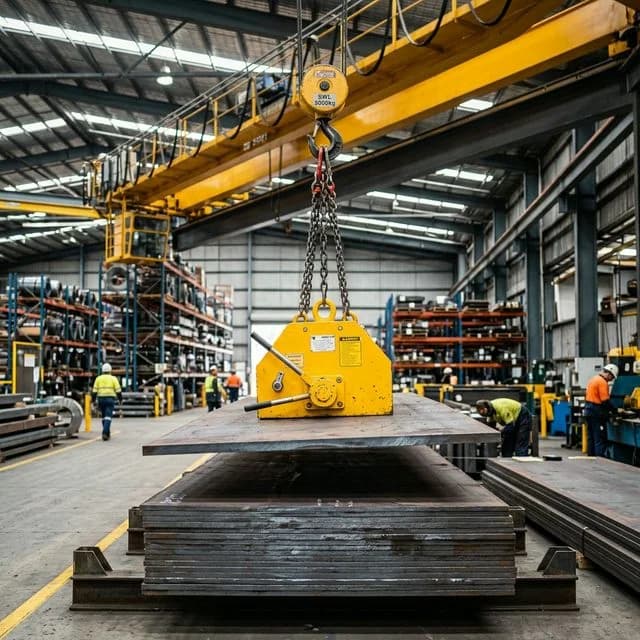
Method, Evidence, and Source Quality
Tool logic is transparent: each factor has a baseline, degradation signal, and explicit policy response.
Factor model table
| Factor | Baseline | Degrade signal | Tool policy | Source |
|---|---|---|---|---|
| Surface/contact state | Clean, dry, flat contact | Scale, paint, oil, or visible gap | Apply explicit derating multipliers and warning prompts. | HSE magnetic lifting guidance + manufacturer SWL table dependence |
| Load profile geometry | Flat plate transfer | Round/irregular sections or limited contact footprint | Increase demand factor and confidence penalty. | HSE notes thickness/type dependence; vendor catalogs provide model-level examples |
| Orientation during lift | Horizontal transfer | Tilt/turn or vertical-face handling | Escalate severity floor and enforce fallback path. | No harmonized public orientation-loss curve confirmed; internal conservative policy is used for screening. |
| Temperature exposure | <=80°C routine environment | >80°C elevated and >150°C boundary-critical | Increase demand factor and add high-temperature warning states. | HSE hot-material caution + OSHA 1910.184(e)(6) thermal limits |
| Cycle and shift accumulation | <=10 lifts/hour and <=8h shift | High cycle drift or long-shift fatigue accumulation | Apply cycle/shift factors and conditional-band triggers. | Operational risk control logic aligned with ergonomic burden signals |
| Proof-test and inspection record pack | Rated-load test records and sling inspection/proof-test records are current and auditable | No 125%-test record, missing latest-inspection month log, or unclear equivalent-entity proof test | Force Conditional/Not recommended until record evidence and ownership are completed. | OSHA 1910.179(k)(2) + OSHA 1910.184(e)(3)(ii)/(e)(4) |
| Load-path governance and control ownership | Pre-lift balance is verified, hook path is centered to prevent swing, motion is smooth/clear of obstructions, no side pull, one-crane normal path, operator stays at controls, and warning signal process is active near personnel | Unverified balance/hook path, abrupt hoist motion, side-pull request, multi-crane lift, suspended-load unattended risk, or route crossing occupied zones | Promote to Conditional/Not recommended until method statement, responsible-person ownership, and warning controls are explicit. | OSHA 1910.179(n)(3)(i)/(ii)(c)/(iii)/(iv)/(ix)/(x)/(xi) + LOLER Reg 8 planning/supervision duty |
Known vs unknown
| Item | Status | Reason | Action |
|---|---|---|---|
| Target load window (1-2 ton class intent) | Known | Directly inferred from keyword and tool inputs. | Use as initial class envelope, then refine by boundary factors. |
| Exact mass basis behind a bare “2 ton” phrase | Partially known | NIST/BIPM sources define the unit conversions, but a search query or supplier title does not prove whether the buyer means short ton, metric tonne, or long ton. | Require kg/lb/short-ton/metric-tonne wording in RFQ and use the tool’s unit selector before comparing offers. |
| Surface/contact quality at production cadence | Partially known | User can input category but real variability can drift by shift. | Capture photo logs and representative test records before release. |
| Exact derating curve by coating thickness and air-gap profile | Unknown | No universal public cross-brand curve found in reviewed primary sources. | Request supplier-specific test data and run site-representative breakaway tests. |
| Material ferromagnetic certainty for each batch | Partially known | May vary by alloy/mix and documentation quality. | Require material traceability in RFQ and incoming checks. |
| Safe stand-off by implant type in your actual lift zone | Unknown | Public guidance flags risk but does not publish a universal distance matrix by implant and magnet model. | Define site-specific restricted zones using supplier field mapping and medical-specialist review. |
| Incident reduction attributable to one specific magnet class | Unknown | Public datasets report broad injury burdens, not class-specific intervention effect sizes. | Track pilot KPIs (near miss, handling deviation, downtime) for your line. |
| Importer-side ownership of UKCA/CE file obligations | Partially known | Ownership can drift when distributor/importer branding or relabeling changes. | Fix documentation ownership in contracts before PO release and archive evidence paths. |
| China-route supervision-inspection ownership and pass-evidence readiness | Partially known | Supplier quotes often state capacity/certificates but leave supervision-inspection scope, importer obligations, and Chinese-document ownership implicit. | Assign named owners for inspection, import document package, and jurisdiction path before shipment authorization. |
| Model-level rare-earth chemistry and substitution plan | Partially known | Most public listing pages disclose capacity and pull-off values but not full NdPr/heavy-RE composition or substitution path. | Add BOM-level declaration, equivalence criteria, and controlled-substitution clause to RFQ and contract. |
| Manufacturer QMS validity and scope match | Partially known | A certificate can be checked, but the scope, site address, accreditation status, and product-family coverage must match the quoted manufacturer and model route. | Validate certificate details in IAF CertSearch or with the issuing body and archive the lookup date before shortlist approval. |
| Manufacturer technical-file completeness for destination market | Partially known | EU/GB/China routes have explicit document duties, but suppliers often send sales PDFs before a full technical-file index. | Request a technical-file index, DoC/conformity route, instructions, risk assessment, and evidence owner for the target market. |
| Supplier role and proof ownership | Partially known | A supplier may be OEM, importer, distributor, stockist, private-label seller, or export intermediary, and each role changes who owns conformity, test, inspection, and document-retention evidence. | Classify supplier role before price comparison and require named evidence owners for certificate validation, test records, technical file, manual, inspection status, and import route. |
| EU notified-body timeline certainty for 2026-2027 launches | Partially known | Regulatory cutover dates are explicit, but public aggregate queue-time data by product class is limited. | Ask suppliers for current notified-body slot evidence and freeze a fallback launch schedule before PO lock. |
| 2025 reporter completeness for China HS 850511/850519 rows | Partially known | World 2025 tables are published, but CHN reporter pages currently show no rows and require coverage validation. | Tag 2025 share conclusions as provisional and verify WITS Data Availability/reporter updates before sourcing strategy changes. |
| U.S. HS 850519 quantity completeness in current WITS snapshot | Partially known | Value rows are visible for World/China, but captured table output omits quantity fields. | Keep destination-side concentration as a value-share signal only and mark any quantity-derived benchmark as pending confirmation. |
Source map and date scope
| Source | Applied claim | Date scope | Link |
|---|---|---|---|
| HSE: Magnetic lifting devices | Warning devices, >20 kg SWL battery trigger behavior, hot-material cautions, and SWL dependency notes (thickness/type). | Page updated Oct 29, 2024; accessed Apr 7, 2026 | Open source |
| HSE INDG379 safe-use guidance PDF | Adds control-level rules: not general-purpose use, active-implant EMF caution, close-proximity redundancy, and two-action release expectations. | PDF guidance accessed May 10, 2026 | Open source |
| OSHA 29 CFR 1910.179 | Defines crane inspection cadence, handling-stage duties (balance-before-lift, hook-over-load anti-swing, no sudden acceleration/deceleration, no-load-over-people, near-rated brake tests), and rated-load testing rules with test reports available to appointed personnel. | Regulation text accessed May 21, 2026 | Open source |
| HSE LOLER overview | Confirms Reg 8 duty triplet (planned by competent person, supervised, safe manner), plus explicit marking and first-use examination boundaries (including DoC <12 months exception conditions). | Page updated Jan 22, 2026; accessed May 21, 2026 | Open source |
| OSHA 29 CFR 1910.184 | Defines daily sling pre-use checks, <=12 month alloy-chain periodic interval, monthly inspection-record retention, pre-use proof testing for new/repaired/reconditioned chain slings, and >600°F / >1000°F thermal actions. | Regulation text accessed May 15, 2026 | Open source |
| OSHA 29 CFR 1926.251 | For construction rigging contexts, custom grabs/hooks/clamps or similar accessories must be SWL-marked and proof-tested to 125% before initial use. | Regulation text accessed May 10, 2026 | Open source |
| OSHA interpretation letter (2007-11-16) | Clarifies that below-the-hook handling fixtures are considered part of the load, so no-load-over-people controls apply to the fixture+load path. | Interpretation dated Nov 16, 2007; accessed May 26, 2026 | Open source |
| OSHA interpretation letter (1999-03-24) | States that lifting over employees is prohibited and indicates a variance route under 29 CFR Part 1905 if an employer claims no feasible alternative. | Interpretation dated Mar 24, 1999; accessed May 26, 2026 | Open source |
| ASME B30.20 (Below-the-Hook Lifting Devices) | ASME publishes B30.20-2025 with scope covering marking, construction, installation, inspection, testing, maintenance, and operation of below-the-hook devices. | Edition listed as B30.20-2025; ASME page accessed May 26, 2026 | Open source |
| ASME BTH-1 (Design of Below-the-Hook Lifting Devices) | ASME lists BTH-1-2023 as design criteria and notes it addresses design requirements only; B30.20 is cited as the companion operation/safety standard. | Edition listed as BTH-1-2023; ASME page accessed May 26, 2026 | Open source |
| ISO 9001:2015 standard page | ISO describes ISO 9001 as the globally recognized quality-management-system standard and the only ISO 9000-family standard that can be certified to, while noting certification is not mandatory. | Current ISO standard page accessed Jun 5, 2026 | Open source |
| ISO: Reaping the benefits of ISO 9001 | ISO explains that ISO 9001 sets QMS requirements and that certification is not required to use the standard; this makes QMS status a supplier-control signal, not product-release proof by itself. | ISO publication page accessed Jun 5, 2026 | Open source |
| IAF CertSearch certificate validation | IAF presents CertSearch as the global database for validating accredited management-system certifications, useful for checking claimed ISO 9001 certificates before manufacturer shortlist approval. | Site accessed Jun 5, 2026 | Open source |
| Your Europe: Preparing technical documentation | For EU-market products under harmonised rules, manufacturers must prepare technical documentation covering design, manufacture, and operation and use it to support the EU Declaration of Conformity and CE marking. | EU Your Europe page accessed Jun 5, 2026 | Open source |
| BS EN 13155 publication index | The index lists BS EN 13155:2020+A1:2025 as current with corrigendum and amendment metadata, useful for standards-version checks in RFQ packages. | Index metadata updated Feb-Mar 2026; accessed May 26, 2026 | Open source |
| GOV.UK product marking table (UKCA/CE regimes) | Shows machinery in Great Britain can use UKCA or CE and cites Oct 1, 2024 legislative update continuing CE recognition path. | Published Jul 31, 2024; accessed May 10, 2026 | Open source |
| GOV.UK UKCA/CE market placement guidance | States route-split by market (GB vs EU/NI), importer/distributor role-shift to manufacturer when own-brand/modification applies, UKCA labeling flexibility through Dec 31, 2027, and typical 10-year technical-document retention. | Published Mar 31, 2026; last updated Apr 7, 2026; accessed May 10, 2026 | Open source |
| HSE: Thorough examinations of lifting equipment | States default thorough-exam cadence patterns used under LOLER pathway (6-month and 12-month routes). | Page updated Oct 29, 2024; accessed Apr 7, 2026 | Open source |
| LOLER 1998 Regulation 9 (legislation.gov.uk) | Formal legal interval basis for 6-month and 12-month thorough examinations (or written scheme). | Legislation metadata updated May 16, 2024; accessed Apr 7, 2026 | Open source |
| PRC Special Equipment Safety Law (SAMR repost, 2023 revision text) | Article 25 requires supervision inspection for manufacturing and installation/major repair of covered equipment; Article 30 requires imported equipment to meet China safety technical norms with Chinese labels/docs; Article 100 separates construction-site crane supervision into construction-authority route. | Law text reposted Apr 18, 2023; accessed May 26, 2026 | Open source |
| TSG 51-2023: Safety Technical Regulations for Cranes | Applies to cranes listed in the Special Equipment Catalogue, excludes construction-site and municipal-site cranes, and requires lifecycle risk factors plus design-life framing in design outputs. | Issued May 23, 2023; effective Jan 1, 2024; accessed May 26, 2026 | Open source |
| SAMR announcement for TSG 51-2023 implementation | Official announcement sets implementation schedule and transition expectation for the new crane safety-technical regulation package. | Published May 24, 2023; accessed May 26, 2026 | Open source |
| GB/T 41098-2021 (Std.SAMR detailed page) | Lists issue/effective dates, scope including lifting magnets/attachments, explicit exclusions for personnel/hazardous lifting families, and ISO 17096:2015 IDT alignment note. | Issued Dec 31, 2021; effective Jul 1, 2022; page accessed May 26, 2026 | Open source |
| GB/T 33545-2017 status page (OpenSTD SAMR) | Confirms current status and implementation date for the lifting-electromagnet general technical-condition standard reference used in China-side evidence checks. | Issued Jul 31, 2017; effective Feb 1, 2018; accessed May 26, 2026 | Open source |
| SAMR 2023 national special-equipment safety bulletin | Reports 2,921,700 cranes in service at year-end 2023, 20 crane accidents with 19 deaths in 2023, and an 84.51% use-stage share for special-equipment accidents. | Published Apr 2, 2024; accessed May 26, 2026 | Open source |
| CDC NIOSH RNLE overview | Provides framing for manual handling risk screening and context for cumulative workload controls. | Updated Feb 21, 2024 | Open source |
| CDC NIOSH NLE calculator update | States LI > 1 indicates increased lifting-related risk in compatible scenarios. | Published Dec 4, 2024 | Open source |
| BLS Employer-Reported Workplace Injuries and Illnesses | Provides 2024 private-industry TRC rate context and points to detailed event-level DART burden tables. | Published Jan 22, 2026 | Open source |
| BLS Table 2 (event/exposure DART detail, 2023-2024) | Reports 946,290 DART cases for overexertion/repetitive-motion/bodily-condition events (44.7 per 10,000 FTE) and 860,050 for contact incidents (40.6 per 10,000 FTE). | Published Jan 22, 2026; accessed May 15, 2026 | Open source |
| USGS Mineral Commodity Summaries 2026: Rare Earths | Shows U.S. 2025 net import reliance at 67% for rare-earth compounds/metals, import-source share led by China (71% for 2021-2024), and world mine production at 390,000 tons with China at 270,000 tons. | Published Feb 2026; accessed May 15, 2026 | Open source |
| USGS Mineral Commodity Summaries 2026: Heavy Rare Earths | Shows U.S. 2025 net import reliance at 100% for heavy rare-earth compounds/metals and documents 2025 China export-control tightening timeline. | Published Feb 2026; accessed May 15, 2026 | Open source |
| World Bank WITS (UN Comtrade), HS 850511 | 2024 export table lists China at $3,236,652.39K and 130,756,000 kg, with top destination rows including the United States. | 2024 trade year; accessed May 10, 2026 | Open source |
| World Bank WITS (UN Comtrade), HS 850511 (2023) | 2023 export table lists China at $3,689,240.73K and 119,566,000 kg, enabling 2023->2024 trend comparison. | 2023 trade year; accessed May 15, 2026 | Open source |
| World Bank WITS (UN Comtrade), HS 850519 | 2024 export table lists China at $502,689.89K and 177,503,000 kg, indicating high value concentration in this magnet subheading. | 2024 trade year; accessed May 10, 2026 | Open source |
| World Bank WITS (UN Comtrade), HS 850519 (2023) | 2023 export table lists China at $485,720.74K and 160,541,000 kg, enabling 2023->2024 trend comparison. | 2023 trade year; accessed May 15, 2026 | Open source |
| World Bank WITS (UN Comtrade), USA imports HS 850511 | 2024 USA import table lists World at $478,125.34K / 9,407,080 kg and China at $359,791.11K / 7,078,860 kg, exposing destination-side concentration for quote normalization. | 2024 trade year; page refreshed May 14, 2026 22:28 ET; accessed May 21, 2026 | Open source |
| World Bank WITS (UN Comtrade), USA imports HS 850519 | 2024 USA import table lists World at $122,766.84K and China at $58,184.41K; captured rows show value but no quantity fields in the extracted table snapshot. | 2024 trade year; page refreshed May 14, 2026 22:28 ET; accessed May 21, 2026 | Open source |
| World Bank WITS (UN Comtrade), HS 850511 (2025) | 2025 world exporter table currently lists top reporters without a China row in the visible results, which requires coverage validation before any share interpretation. | 2025 trade year; accessed May 21, 2026 | Open source |
| World Bank WITS (UN Comtrade), HS 850519 (2025) | 2025 world exporter table currently lists top reporters without a China row in the visible results, reinforcing the need to verify reporter completeness. | 2025 trade year; accessed May 21, 2026 | Open source |
| World Bank WITS reporter pages (CHN, 2025, HS 850511 / 850519) | China reporter pages currently display “did not exports ... to All Countries in 2025” for both subheadings, indicating coverage/availability uncertainty for year-over-year comparisons. | 2025 trade year; page refreshed May 21, 2026 08:17 ET; accessed May 21, 2026 | Open source |
| WITS User Manual (Data Retrieval) | States that trade data are reported (not gap-filled) and that missing country-period data generally means the reporter did not submit data for that period. | Manual reference consulted May 21, 2026 | Open source |
| World Bank WITS (UN Comtrade), China partner table HS 850519 | Provides destination-level values and quantities used to compute top3/top5 concentration and lane-level $/kg dispersion proxies. | 2024 trade year; accessed May 10, 2026 | Open source |
| UN Comtrade HS 8505 heading definition | HS 8505 group scope covers multiple magnetic product families, not only permanent lifting magnets. | UN Comtrade code table accessed May 10, 2026 | Open source |
| EUR-Lex Regulation (EU) 2023/1230 (Machinery) | Sets legal cutover timing: Directive 2006/42/EC repealed from Jan 14, 2027; Regulation applies from Jan 14, 2027; EC type-exam certificates under Directive 2006/42/EC remain valid until expiry. | Official Journal L 165 (Jun 29, 2023); accessed May 15, 2026 | Open source |
| IAF CertSearch | Positions itself as the global accredited-management-system certification validation database. | Site metadata accessed May 10, 2026 | Open source |
| Supplier-role evidence synthesis | Separates 2 ton magnetic lifter supplier proof by role: OEM, distributor/importer, stockist/used seller, private-label or modified package, and China export supplier. | Derived from HSE, OSHA, ISO/IAF, EU, GOV.UK, SAMR, and supplier-catalog checks; updated Jun 9, 2026 | Open source |
| IMI PowerLift product table | Provides market-visible model points and states WLL as 33% of actual value. | Accessed Apr 7, 2026 | Open source |
| Steelmax Max Lifter page | Provides examples of 550/1100/2200/4400 lb model classes and 3x test framing language. | Accessed Apr 7, 2026 | Open source |
| NIST Handbook 44 Appendix C (2026) | Provides U.S. customary mass-unit boundaries, including short ton at 2,000 lb and long ton at 2,240 lb; NIST also notes “tn” is the required abbreviation for short ton. | 2026 edition; searched/accessed Jun 5, 2026 | Open source |
| BIPM kilogram SI base unit page | Defines kilogram (kg) as the SI unit of mass, anchoring this page’s normalized calculation basis. | Current BIPM page accessed Jun 5, 2026 | Open source |
Regulatory Triggers and Evidence Limits
This layer converts source text into operational triggers and also marks where public evidence is still incomplete.
Clause-level trigger matrix (US + UK + China)
| Regime | Clause | Trigger | Threshold | Decision impact | Source |
|---|---|---|---|---|---|
| HSE magnetic lifting guidance (UK) | Electrical supply protection | Battery-fed / external-supply systems above SWL threshold | >20 kg SWL: warning and backup behavior should protect holding margin | Require controls proving warning and backup sequence before high-consequence deployment. | HSE magnetic lifting devices |
| HSE magnetic lifting guidance (UK) | Temperature of load and magnet | Hot material segments | Ferrous materials can cease to be magnetic around 700°C; use only special hot-work-rated magnets within limits | Nominal class is invalid without a declared temperature envelope and accessory compatibility. | HSE magnetic lifting devices |
| OSHA 29 CFR 1910.179 (US) | 1910.179(j)(1)(ii) | Crane operations in regular service | Frequent inspection daily-monthly; periodic inspection 1-12 months | If inspection cadence ownership is unclear, hold release even when selector result looks favorable. | OSHA 1910.179 |
| OSHA 29 CFR 1910.179 (US) | 1910.179(g)(5)(v) | Lifting-magnet control circuit design | A lock-open magnet circuit switch and an inductive-load discharge path are required | Reject supplier/control packages that lack explicit lock-open and discharge controls for energized lifting magnets. | OSHA 1910.179 |
| OSHA 29 CFR 1910.179 (US) | 1910.179(n)(3)(i) | Load starts without pre-lift balance check | Load must be well secured and properly balanced before being lifted more than a few inches | If pre-lift balance evidence is missing, hold release even when class label appears adequate. | OSHA 1910.179 |
| OSHA 29 CFR 1910.179 (US) | 1910.179(n)(3)(ii)(c) | Hook path is not centered over the load | Hook should be brought over the load in a way that prevents swinging | Treat misaligned hook path as a stop condition until rigging/hook path control is corrected. | OSHA 1910.179 |
| OSHA 29 CFR 1910.179 (US) | 1910.179(n)(3)(iii)(a)-(b) | Hoisting includes abrupt motion or obstacle contact risk | During hoisting there should be no sudden acceleration/deceleration and no load contact with obstructions | Quick pricelist wins are non-actionable if motion-profile and clearance controls are not defined. | OSHA 1910.179 |
| OSHA 29 CFR 1910.179 (US) | 1910.179(n)(3)(vi) | Operator handling path includes occupied zones | Operator must avoid carrying loads over people | If route control cannot guarantee this condition, hold quick-release decisions and redesign lift path. | OSHA 1910.179 |
| OSHA interpretation letter (2007-11-16) | 1910.179(n)(3)(vi) application boundary | Team assumes no-load-over-people rule applies only to payload, not fixtures | OSHA interpretation treats below-the-hook handling fixtures as part of the load | Apply no-load-over-people and route-isolation controls to the full fixture+payload envelope, not payload alone. | OSHA interpretation (2007-11-16) |
| OSHA 29 CFR 1910.179 (US) | 1910.179(n)(3)(vii) | Load approaches rated load handling condition | Operator must brake-test by raising a few inches and applying brakes | Near-rated handling requires explicit brake-test procedure ownership before production release. | OSHA 1910.179 |
| OSHA 29 CFR 1910.179 (US) | 1910.179(n)(3)(iv) | Route or fixture forces side pull | Side pulls are prohibited unless specifically authorized by a responsible person after checking stability and stresses | If side pull cannot be eliminated and responsible-person authorization is absent, hold release and redesign handling path. | OSHA 1910.179 |
| OSHA interpretation letter (1999-03-24) | 1910.179(n)(3)(vi) enforcement/variance path | Employer claims no feasible way to avoid carrying loads over people | OSHA interpretation cites variance process under 29 CFR Part 1905 instead of bypassing the prohibition | Escalate to formal variance/legal review path rather than treating overhead lifting over personnel as an acceptable default. | OSHA interpretation (1999-03-24) |
| OSHA 29 CFR 1910.179 (US) | 1910.179(n)(3)(ix) | Two or more cranes lifting one load | One qualified responsible person must be in charge of the operation | Treat multi-crane lifts as non-releaseable until accountable lift leadership is named and method ownership is explicit. | OSHA 1910.179 |
| OSHA 29 CFR 1910.179 (US) | 1910.179(n)(3)(x) | Suspended load with operator handoff/absence risk | The operator should not leave controls while the load is suspended | If control-station continuity is not guaranteed, keep output at conditional or stop status regardless of class label. | OSHA 1910.179 |
| OSHA 29 CFR 1910.179 (US) | 1910.179(n)(3)(xi) | Load approaches personnel not in direct operation | A warning signal shall be sounded when approaching those not in charge, unless warning signs are visible from all directions | Near-person travel routes need warning-signal ownership or visible warning signage before release. | OSHA 1910.179 |
| OSHA 29 CFR 1910.179 (US) | 1910.179(k)(2) + 1910.179(m)(1) | Pre-commissioning and ongoing records control for cranes | Rated-load tests must not exceed 125% unless manufacturer recommends otherwise; test reports must be available to appointed personnel | Hold commissioning when test report ownership is unclear, even if catalog class appears sufficient. | OSHA 1910.179 |
| OSHA 29 CFR 1910.184 (US) | 1910.184(d), (e)(3)(i), (e)(6) | Sling condition and heat exposure | Daily pre-use inspection; alloy-chain periodic interval <=12 months; >600°F derate WLL; >1000°F remove from service | Hot-work and rigging-condition checks are gating controls, not optional documentation. | OSHA 1910.184 |
| OSHA 29 CFR 1910.184 (US) | 1910.184(e)(3)(ii) + 1910.184(e)(4) | Alloy chain sling release into service | Keep record of most recent inspection month per sling; new/repaired/reconditioned slings must be proof tested before initial use | Reject RFQ acceptance if sling records/proof-test certificates are absent or ownership is undefined. | OSHA 1910.184 |
| LOLER Regulation 8 (UK) | Reg. 8(1)(a)-(c) | Any lifting operation involving lifting equipment | Operation must be properly planned by a competent person, appropriately supervised, and carried out in a safe manner | Class-selection output is non-actionable until named planning/supervision ownership exists in the operation method. | LOLER Reg 8 (legislation.gov.uk) |
| LOLER Regulation 9 (UK) | Reg. 9(3)(a)(i)-(ii) | Jurisdictional examination schedule | 6 months for lifting persons/accessories; 12 months for other lifting equipment (or written scheme) | For UK deployments, OSHA-only cadence is incomplete and must be mapped to LOLER obligations. | Legislation.gov.uk + HSE LOLER page |
| PRC Special Equipment Safety Law | Article 25 | Crane manufacturing or installation/major repair is planned before delivery or commissioning | Covered work must pass supervision inspection by designated special-equipment inspection institutions before delivery/use | Do not release supplier shortlist if supervision-inspection ownership, scope, or pass evidence is missing. | SAMR law text (Art. 25) |
| PRC Special Equipment Safety Law | Articles 30-31 | Importer plans to ship magnetic-lifter equipment into China | Imported equipment must meet China safety technical norms, pass inspection, and provide Chinese labels/instructions/warnings; designated categories also require pre-import notice | A class-fit result is non-actionable without import-route compliance owner and document package readiness. | SAMR law text (Arts. 30-31) |
| TSG 51-2023 (China crane technical regulation) | Scope + design-risk clauses | Teams assume one governance path for all crane-like scenarios | Applies to cranes in the Special Equipment Catalogue, excludes construction-site and municipal-site cranes, and requires lifecycle risk consideration with defined design service life | Split compliance path early (special-equipment vs construction-site authority) and require lifecycle-risk evidence in technical files. | TSG 51-2023 text + SAMR notice |
| GB product marking (machinery) | UKCA/CE sector table + Oct 1, 2024 recognition update | China-made machinery entering Great Britain market | Machinery route allows UKCA or CE in GB, with importer duties | Do not finalize supplier shortlist until conformity route and technical-file ownership are contractually clear. | GOV.UK product marking by sector |
HSE control gates from safe-use guidance
| Control | Requirement | Applies when | Risk if missed | Source |
|---|---|---|---|---|
| Active-implant EMF boundary | Workers with active body implants (for example pacemakers/insulin pumps/defibrillators) may be affected; medical-specialist input and zone controls are required. | Any magnetic lift zone where personnel with implants may be present. | Sizing may look valid while personnel-safety boundary remains unmanaged. | HSE safe-use magnetic lifting PDF |
| Close-proximity redundancy | Where magnets operate close to persons, provide duplicated power cables/connections/controller or a secondary positive holding device. | Battery-fed or external-power magnets used near occupied zones. | Single-point power/control failure can escalate to dropped-load exposure. | HSE safe-use magnetic lifting PDF |
| Inadvertent-release prevention | Releasing the load should require two control actions. | Pendant/remote control operations under repetitive cycle pressure. | Single-action misoperation can trigger unintended release. | HSE safe-use magnetic lifting PDF |
| Not-general-purpose suitability boundary | Magnetic lifting devices are not general-purpose gear; supplier suitability check should include mass, shape, dimensions, structural stiffness, and magnetic properties. | New workpiece family or profile changes in production. | Nominal class labels can be over-applied to incompatible load families. | HSE safe-use magnetic lifting PDF |
| Load-jump and route control | Define travel routes and assess jump-up risk; one control path is lowering a de-energized magnet onto the load first. | Large-load starts, oversize plates, or magnets smaller than load footprint. | Impact at pickup and route drift can damage plant or injure personnel. | HSE safe-use magnetic lifting PDF |
Counterexamples where nominal class still fails
| Scenario | Why nominal fails | Source signal | Minimum safer path |
|---|---|---|---|
| Scrap or multi-piece lift where peripheral pieces are weakly coupled | Part of the load can fall off even if nominal SWL is not exceeded because magnetic flux penetration is uneven. | HSE warns poor peripheral penetration in multi-piece/scrap handling. (HSE magnetic lifting devices) | Treat as engineered special case: trial with containment controls and conservative de-rating. |
| Bundle lifting using transit banding that is not rated for lifting | Load integrity fails before magnet nominal class does, creating dropped-load risk. | HSE states banding must be rated for lifting duties and marked with SWL. (HSE magnetic lifting devices) | Use rated lifting accessories only; reject transit-only strapping for lifting. |
| Mobile crane with magnetic attachment and travel/slewing inertia | Dynamic effects can exceed assumptions behind static class naming. | HSE advises consulting crane manufacturer and possible SWL de-rating or disallowance. (HSE magnetic lifting devices) | Obtain crane-manufacturer compatibility guidance before deployment. |
| Material thickness/profile differs from supplier lifting tables | SWL tables are thickness/type dependent; mismatch can invalidate expected capacity. | HSE notes SWL is normally quoted for specific thickness and material type. (HSE magnetic lifting devices) | Match workpiece thickness/profile to supplier table and confirm by representative tests. |
Evidence boundaries (stage1b)
| Topic | Status | Reason | Minimum action |
|---|---|---|---|
| Supplier-level model capacities and WLL framing | Verified | IMI and Steelmax publish model ranges and WLL/test framing, but these are vendor-specific, not universal standards. | Use as market comparison input only; verify acceptance tests in each RFQ. |
| Universal air-gap/paint-thickness derating curve across brands | No reliable public dataset yet | No harmonized open dataset found in reviewed HSE/OSHA/regulatory pages or vendor catalogs. | Request supplier pull-force vs air-gap/coating data and run site-representative breakaway tests. |
| Orientation-specific failure-rate benchmark with public denominator | Pending confirmation | Public sources provide rules and cautions, but not a shared quantitative failure-rate benchmark by orientation path. | Track your own pilot KPIs by orientation transition and set stop criteria before scaling. |
| Implant-specific stand-off distance by magnet model and duty cycle | No reliable public dataset yet | HSE flags active-implant sensitivity around EMF, but no universal stand-off table exists across magnet designs and medical implants. | Use supplier field maps plus site medical policy before assigning implant users to lift zones. |
| Class-specific injury reduction attributable to 1-ton vs 2-ton choice | No reliable public dataset yet | BLS/NIOSH provide broad burden context, not causal effect sizes tied to specific magnet class selection. | Treat injury statistics as context; evaluate local outcome data after pilot rollout. |
| Public, product-level failure benchmark by exact HS subheading plus lifting architecture | Pending confirmation | Trade datasets are rich on value/quantity but do not provide a shared failure-rate denominator by magnet architecture. | Combine public trade signals with supplier proof-test data and local pilot outcomes before final sourcing lock. |
| Model-level NdPr/heavy-rare-earth composition disclosure for 2-ton permanent lifters | Pending confirmation | Public catalogs and trade datasets generally do not publish complete magnet chemistry/BOM disclosure by model. | Treat as supplier-controlled evidence: request signed material declaration and change-notice obligation before PO release. |
| China public accident denominator for magnetic-lifter subtypes (permanent vs electromagnetic) | No reliable public dataset yet | SAMR publishes crane-level annual safety baselines, but reviewed public bulletins do not provide a harmonized subtype split for magnetic-lifter architectures. | Use national crane baseline as context only and require supplier/site incident logs by magnet architecture before scaling rollout. |
| Public benchmark for notified-body cycle times in 2026-2027 machinery transition windows | No reliable public dataset yet | Reviewed primary regulatory texts define obligations and dates, but do not publish a harmonized queue-time benchmark by machinery category and member state. | Treat conformity lead time as project-specific risk: request supplier lead-time evidence and add schedule buffer before launch commitment. |
| U.S. 2024 HS 850519 import quantity completeness in WITS rows | Pending confirmation | Captured WITS USA HS 850519 rows provide trade value but do not show quantity fields in the extracted table snapshot. | Do not compute destination-side $/kg from this snapshot; keep value-share logic only and request weight-normalized supplier evidence separately. |
| 2025 China reporter completeness for HS 850511 / HS 850519 | Pending confirmation | WITS world 2025 tables are available, but CHN reporter pages currently show no export rows for both subheadings; WITS also states data are reported and not gap-filled. | Do not infer structural market change from 2025 CHN absence alone; keep 2024 concentration metrics as baseline and re-check coverage before trend decisions. |
| Public crosswalk dataset mapping OSHA clauses to ASME B30.20/BTH-1 checkpoints for magnetic-lifter acceptance | No reliable public dataset yet | Primary sources define their own scopes, but no unified open crosswalk table was found that maps clause-level equivalence for 1-2 ton magnetic-lifter procurement. | Build a project-specific crosswalk in the RFQ package and require supplier responses by clause and evidence owner. |
| Universal public manufacturer ranking for 2 ton magnetic lifter reliability | No reliable public dataset yet | Reviewed public sources support certificate validation, standards scope, and technical-file requirements, but do not provide a harmonized failure-rate ranking by manufacturer and exact 2-ton model. | Do not publish or rely on a “best manufacturer” claim without auditable denominator data; use supplier-specific certificates, test records, incident logs, and pilot results instead. |
| Model-specific production-lot traceability across manufacturers | Pending confirmation | ISO 9001 and technical-documentation rules support process evidence, but public catalog pages rarely disclose lot-level magnet chemistry, adhesive/fixture controls, or controlled-substitution history. | Request lot traceability, material declaration, substitution notice terms, and latest nonconformance/corrective-action summary under NDA before award. |
| Universal public supplier ranking for 2 ton magnetic lifter readiness | No reliable public dataset yet | Reviewed public sources support role-specific evidence checks, but do not provide a harmonized supplier ranking across OEMs, distributors, importers, stockists, and private-label sellers. | Do not rely on “best supplier” claims without denominator data. Score each supplier by role ownership, serial/test evidence, conformity route, document owner, and site-representative pilot result. |
| Used-equipment history and prior-overload condition across stockist listings | Pending confirmation | Public inventory pages can show model class and availability, but generally do not expose complete prior-use, overload, repair, examination, and accessory-mismatch history. | Treat used or stock offers as conditional until the seller provides serial identity, condition report, latest inspection/proof-test record, manual, and accessory compatibility evidence. |
China-Sourcing Signals and Decision Gates
This section converts current public trade and compliance signals into RFQ-stage checks, while explicitly marking classification, jurisdiction, and evidence-completeness boundaries.
Signal-to-action matrix (updated May 26, 2026, round 2)
| Signal | Finding | Risk if ignored | Minimum action | Source |
|---|---|---|---|---|
| HS 850511 value concentration (2024) | WITS reports China at $3,236,652.39K versus Japan at $401,635.51K (about 8.06x by export value). | Single-country dependency risk can be underestimated during lead-time or policy shifts. | Qualify at least one secondary route and keep equivalent test acceptance criteria ready. | WITS HS 850511 exporter table |
| HS 850519 value concentration (2024) | WITS reports China at $502,689.89K versus Germany at $101,188.26K (about 4.97x by export value). | Quote comparisons can miss concentration risk in adjacent permanent-magnet classes. | Use dual-source RFQ lanes for critical workflows and request comparable proof-test packs. | WITS HS 850519 exporter table |
| U.S. destination-side concentration in HS 850511 imports (2024) | WITS USA import rows show World $478,125.34K / 9,407,080 kg and China $359,791.11K / 7,078,860 kg (about 75.25% of value). | Teams may compare EXW/FOB supplier quotes without accounting for destination-side concentration and landed-value context. | Use destination-side lane normalization for U.S.-bound decisions before ranking suppliers by price. | WITS USA imports HS 850511 |
| U.S. HS 850519 quantity visibility boundary (2024) | WITS USA import rows show World $122,766.84K and China $58,184.41K (about 47.39% of value), but extracted rows do not include quantity values. | Any $/kg benchmark derived from this snapshot can introduce false precision. | Tag weight-normalized comparison as pending confirmation and require supplier-provided weight/test-basis records for award decisions. | WITS USA imports HS 850519 |
| Destination exposure in China HS 850511 flow | China 2024 HS 850511 partner rows include the U.S. at 17,748,500 kg and $395,313.45K. | Teams may miss destination-sensitive routing or compliance checkpoints in contract planning. | Add destination-specific compliance gates before locking Incoterms and shipment windows. | WITS China partner table (HS 850511) |
| HS scope boundary | HS 8505 is broader than lifting magnets, so trade totals can mix multiple magnetic product families. | Cross-supplier benchmarks can compare non-equivalent products and create false precision in pricing/risk decisions. | Lock HS subheading and product architecture in RFQ before using market aggregates as decision evidence. | UN Comtrade HS 8505 heading scope |
| 2023->2024 value-vs-volume divergence in China export flows | HS 850511 moved from $3,689,240.73K / 119,566,000 kg (2023) to $3,236,652.39K / 130,756,000 kg (2024), while HS 850519 moved from $485,720.74K / 160,541,000 kg to $502,689.89K / 177,503,000 kg. | Price-only ranking can ignore architecture/test-basis drift when implied unit values compress while volume rises. | Add cross-year comparability gate: same HS subheading, same test basis, same accessory scope before accepting the lowest quote. | WITS HS 850511 + HS 850519 (2023/2024) |
| 2025 reporter continuity anomaly in CHN pages | WITS CHN 2025 reporter pages for HS 850511 and HS 850519 currently show “did not exports ... to All Countries” with empty row tables, while world 2025 tables still publish other reporter data. | Teams can misread missing reporter data as immediate structural market collapse and make over-reactive sourcing decisions. | Mark 2025 CHN share inference as pending confirmation, validate WITS Data Availability coverage, and keep 2024 China concentration metrics as the latest confirmed baseline. | WITS CHN reporter page + WITS manual caveat |
| U.S. rare-earth import dependence (2025) | USGS reports net import reliance of 67% for rare-earth compounds/metals and 100% for heavy rare-earth compounds/metals. | A “for sale” quote can look competitive while upstream NdPr/heavy-RE availability remains fragile. | Request material-origin disclosure and alternate-source plan for critical RE inputs in every final-round RFQ. | USGS MCS 2026 rare earth chapters |
| 2025 rare-earth export-control timeline | USGS records China tightening controls in April 2025, expanding in October, then partially suspending October controls in November while April controls remained. | Procurement plans may assume steady availability despite regulatory shifts in upstream critical inputs. | Set contract triggers for export-control change events and predefine substitution/stock-buffer actions. | USGS MCS 2026 rare earth chapters |
| Certification authenticity check path | IAF CertSearch is positioned as a global validation database for accredited management-system certifications. | Factory qualification can rely on unverifiable certificate claims. | Validate supplier certificate numbers in IAF CertSearch and record the lookup in sourcing QA. | IAF CertSearch |
| China legal inspection gate before delivery/use | PRC Special Equipment Safety Law Article 25 requires supervision inspection for covered manufacturing and installation/major-repair work; uninspected or failed equipment cannot be delivered or used. | Commercially attractive offers can still fail legal release if supervision-inspection evidence is incomplete. | Require supervision-inspection responsibility and pass-evidence ownership in RFQ and contract milestones. | SAMR law text (Art. 25) |
| China import route evidence gate | Articles 30-31 require imported special equipment to satisfy China safety technical norms, pass inspection, and include Chinese labels/instructions/warnings, with designated categories requiring pre-import notification. | Importer-side nonconformance can block customs/commissioning even when model sizing is acceptable. | Lock importer compliance owner and verify inspection + Chinese-document package before shipment release. | SAMR law text (Arts. 30-31) |
| China operational-risk baseline from regulator bulletin | SAMR reports 2,921,700 cranes in service (end 2023), 20 crane accidents and 19 deaths in 2023, and 84.51% accident share in use-stage links. | Teams may underweight execution controls and over-trust class labels during quote-driven decisions. | Treat operating controls, supervision ownership, and release checklists as hard gates alongside pricing and capacity. | SAMR 2023 safety bulletin |
Quantified concentration metrics (2024)
| Metric | HS | Value | Decision meaning | Source |
|---|---|---|---|---|
| Destination concentration share | 850511 | Top3: 39.64% of value; Top5: 53.23% of value (China exports, 2024). | Treat single-country single-lane booking as a continuity risk for critical launch windows. | WITS China partner table (HS 850511) |
| Destination concentration share | 850519 | Top3: 28.12% of value; Top5: 41.80% of value (China exports, 2024). | Use second-source readiness for projects with tight recovery-time targets. | WITS China partner table (HS 850519) |
| China crane fleet baseline | Regulatory baseline | 2,921,700 cranes in service at year-end 2023. | Treat release controls as a scale problem: operational discipline and document ownership must be explicit for large-volume ecosystems. | SAMR 2023 safety bulletin |
| China crane incident baseline | Regulatory baseline | 2023: 20 accidents / 19 deaths; use-stage share 84.51%. | Quote advantages should not bypass method controls and supervision records at commissioning. | SAMR 2023 safety bulletin |
| U.S. import concentration share | 850511 | World: $478,125.34K / 9,407,080 kg; China: $359,791.11K / 7,078,860 kg (~75.25% by value). | For U.S.-bound pricelist decisions, normalize destination lane and Incoterm before comparing supplier quotes. | WITS USA imports HS 850511 |
| U.S. import concentration share + data boundary | 850519 | World: $122,766.84K; China: $58,184.41K (~47.39% by value), with no quantity shown in captured table rows. | Treat quantity-based unit-value benchmarking as pending confirmation; do not force $/kg comparisons from incomplete rows. | WITS USA imports HS 850519 |
| Lane unit-value dispersion proxy | 850511 | U.S. lane ≈ $22.27/kg vs India lane ≈ $7.80/kg (about 2.85x spread). | Do not benchmark suppliers on headline $/kg only; lock architecture and test basis before price comparison. | WITS China partner table (HS 850511) |
| Lane unit-value dispersion proxy | 850519 | U.S. lane ≈ $4.23/kg vs India lane ≈ $1.99/kg (about 2.12x spread). | Weight-only price comparisons can hide specification and compliance-pack differences. | WITS China partner table (HS 850519) |
| Cross-year value/quantity direction | 850511 | China exporter row: value -12.27% YoY (2023->2024), quantity +9.36% YoY. | Treat falling unit-value signals as a comparability warning, not automatic procurement gain. | WITS HS 850511 exporter tables (2023/2024) |
| Cross-year value/quantity direction | 850519 | China exporter row: value +3.49% YoY (2023->2024), quantity +10.57% YoY. | Require same-spec equivalence checks before using lower implied $/kg as award evidence. | WITS HS 850519 exporter tables (2023/2024) |
| Reporter-coverage continuity warning | 850511 / 850519 | CHN 2025 reporter pages currently show no export rows for both subheadings (“did not exports ...”). | Treat 2025 China share conclusions as pending confirmation; use 2024 concentration metrics as current decision baseline until coverage is validated. | WITS CHN reporter pages (2025) |
| China standard applicability boundary | GB/T 41098-2021 | Issued 2021-12-31, effective 2022-07-01; scope includes lifting magnets but excludes lifting people/molten metal/harmful items/flexible slings. | A single standard citation is insufficient for special-case lifts; route to specialized controls when exclusions are triggered. | Std.SAMR GB/T 41098 detailed page |
| China crane-regulation transition marker | TSG 51-2023 | Issued 2023-05-23; effective 2024-01-01. | For China-route projects spanning 2023-2024 dossiers, verify that technical files align with the new regulation set. | TSG 51-2023 + SAMR notice |
| World mine production concentration | Rare earths (all) | China 270,000 t of 390,000 t world output in 2025 (~69.2%). | Use upstream supply-risk checks before locking price-only awards for 2-ton magnet procurement. | USGS MCS 2026 Rare Earths |
| Import mix volatility signal | U.S. rare earth compounds/metals | Import volume rose to 21,000 t in 2025 (+169% YoY), while import value shifted to $165M from $168M. | Unit pricing can move with product mix, not just market “stability”; require chemistry- and test-basis comparability. | USGS MCS 2026 Rare Earths |
Applicability boundaries (market + site)
| Boundary | Applies when | Requirement | Risk if missed | Minimum action | Source |
|---|---|---|---|---|---|
| China special-equipment route vs construction-site jurisdiction split | A project mixes plant handling with building-site or municipal-site lifting activities. | TSG 51-2023 applies to cranes in the Special Equipment Catalogue and excludes building-site and municipal-site cranes; law text assigns those site routes to construction-authority supervision. | Teams may pass one authority pathway while failing the other at deployment. | Classify each use scenario by jurisdiction at RFQ stage and assign the matching compliance owner before PO lock. | TSG 51-2023 + Special Equipment Safety Law Art. 100 |
| China import-document gate (equipment + language) | Equipment is sourced from overseas suppliers for use or sale in China. | Imported special equipment must satisfy China safety technical norms, pass inspection, and include Chinese labels/instructions/warnings (with designated categories requiring pre-import notice). | Import clearance or commissioning can fail even when model selection and pricing are approved internally. | Set importer evidence checklist (inspection, Chinese documentation, notice obligation) as a hard release gate. | Special Equipment Safety Law Arts. 30-31 |
| China standard-scope boundary vs special-case lifting | A quote cites GB/T 41098 as full compliance proof for all lift contexts. | Std.SAMR scope lists explicit exclusions (people lifting, molten metal, harmful items, flexible slings) even though the standard includes lifting-magnet families. | Projects can over-claim compliance and under-control higher-consequence lift scenarios. | Treat excluded scenarios as engineered special cases and require dedicated controls beyond generic standard citation. | GB/T 41098 detailed scope (Std.SAMR) |
| GB vs EU/NI market route split | One supplier quote is intended for multiple destinations (GB, EU, or NI). | GOV.UK GB guidance explicitly points to separate processes for EU and NI placement routes. | A file valid for GB can still fail destination-market access. | Lock destination market in RFQ and attach route-specific conformity checklist. | GOV.UK UKCA/CE market placement guidance |
| Importer/distributor role-shift to manufacturer | UK importer or distributor places product under own name/trademark or modifies compliance-relevant design. | The economic operator then assumes manufacturer responsibilities. | Certificate and technical-file ownership can become legally invalid at contract execution. | Name conformity owner, DoC owner, and document-retention owner in the contract. | GOV.UK UKCA/CE market placement guidance |
| Documentation horizon and marking placement window (GB) | Teams plan labeling/document-pack process for 2026-2027 launches. | UKCA can be placed on label/accompanying document until Dec 31, 2027; technical documentation is typically kept for 10 years. | Late audit gaps can block shipment or trigger corrective holds. | Create a retention register with owner, repository, and expiry dates before PO release. | GOV.UK UKCA/CE market placement guidance |
| EU machinery legal cutover (Directive 2006/42/EC -> Regulation 2023/1230) | The same product line is planned for EU shipments around 2026-2027 transition windows. | EUR-Lex sets Directive 2006/42/EC repeal and default Regulation application from Jan 14, 2027, with Article 54(2) listing a subset that applies from Jan 20, 2027. | A GB-ready dossier can still miss EU timing obligations at launch or renewal points. | Tag each shipment by jurisdiction and go-live date, then validate dossier path against the 2027 cutover timeline before award. | EUR-Lex Regulation (EU) 2023/1230 |
| Legacy EC type-examination certificate carryover | Supplier evidence pack relies on Directive 2006/42/EC EC type-examination certificates in the transition period. | Article 52 states EC type-examination certificates issued under Directive 2006/42/EC remain valid until expiry. | Teams may invalidate usable certificates too early or, conversely, miss expiry and launch with stale conformity evidence. | Record certificate expiry dates in RFQ governance and set renewal triggers before commercialization windows. | EUR-Lex Regulation (EU) 2023/1230 |
| Construction-site custom accessory proof-test trigger | Deployment falls under OSHA construction rigging scenarios with custom grabs/hooks/clamps or similar accessories. | 29 CFR 1926.251(a)(4) requires SWL marking and proof test to 125% before initial use. | Factory catalog evidence may not satisfy site-acceptance requirements. | Add 125% proof-test certificate/witness gate to pre-mobilization checklist. | OSHA 1926.251 |
| US legal-text baseline vs consensus-standard evidence scope | Supplier documentation cites ASME B30.20/BTH-1 while project acceptance is checked only against OSHA text, or vice versa. | OSHA 1910.179 incorporates ANSI B30.2.0-1967 for cranes, while ASME B30.20-2025 and BTH-1-2023 set below-the-hook operation/design criteria that are commonly used in procurement governance. | Teams can pass one document route but still miss acceptance evidence required by customer EHS policy or insurer audits. | Run a two-layer checklist before award: mandatory OSHA clauses and explicitly required consensus-standard clauses. | OSHA 1910.179 + ASME B30.20/BTH-1 |
| LOLER operational duty baseline (planning/supervision/safe execution) | Any UK-aligned lifting operation where teams want to apply a quick tool output directly into release action. | Regulation 8 requires every lifting operation to be planned by a competent person, supervised, and carried out in a safe manner. | Teams can over-trust class output while operational control ownership is undefined. | Attach named competent planner, supervisor, and execution owner to each lift method before release. | LOLER Reg 8 (legislation.gov.uk) |
| LOLER first-use examination and non-passenger marking boundary | Commissioning new equipment with a recent Declaration of Conformity or operating non-passenger lifting equipment near personnel pathways. | HSE LOLER overview notes non-passenger equipment should be clearly marked and explains that initial thorough examination may not be needed only where DoC is <12 months and safety does not depend on installation/assembly conditions. | Desktop conformity checks can pass while first-use safety controls or misuse-prevention markings remain incomplete. | Keep a first-use decision record (DoC age + installation dependence) and verify non-passenger markings before go-live. | HSE LOLER overview |
Boundaries and Decision Limits
This page marks explicit non-go zones and gives a minimum executable fallback path for each one.
High-priority limits
- - Unknown/mixed material family: do not release quick class decision without material certainty.
- - Vertical-face handling: treat as out-of-scope for fast permanent-lifter sizing.
- - Elevated/hot material segments: add high-temperature controls before final model lock.
- - Contact-quality uncertainty: require representative breakaway/proof-test records.
- - Inspection-cadence gaps: no release until recurring checks and ownership are documented.
Minimum fallback path
- 1. Keep output in screening mode (do not approve release).
- 2. Collect missing evidence (material/contact/temperature).
- 3. Run controlled pilot with explicit acceptance and stop criteria.
- 4. If risk remains high, switch to alternative architecture before procurement lock.
Comparison and Risk Tradeoffs
Compare alternatives in the same decision frame instead of treating all “2 ton” offers as equivalent.
Option comparison
| Option | Capacity band | Reliability | Best for | Tradeoff |
|---|---|---|---|---|
| Permanent manual magnet (single unit) | Commonly 1-2.5 ton catalog classes | High when contact and posture remain controlled | Power-free repetitive steel handling with stable setup | Margin drops fast with poor surface/orientation drift |
| Electro-permanent or battery-assisted magnet | Broader classes; often higher operational flexibility | High with maintained power/monitoring systems | Sites needing frequent flexibility and automated controls | Higher system complexity and control dependencies |
| Electromagnet + beam/control package | Higher-duty heavy handling ranges | Strong for integrated high-volume lines | Large-yard or mill workflows with engineered infrastructure | Power/control architecture and capex requirements |
| Clamp/vacuum/alternative gripping methods | Material and geometry dependent | Can outperform magnets in non-ferrous or special surfaces | Non-magnetic materials or unsuitable contact geometry | Different failure modes and setup constraints |
Risk matrix
| Risk | Probability | Impact | Mitigation |
|---|---|---|---|
| Nominal class selected without contact-condition evidence | High | High | Require representative breakaway test records and pre-use contact checks. |
| Orientation changes from horizontal to vertical during handling | Medium | High | Treat orientation changes as boundary-critical and pre-approve engineered method controls. |
| Pre-lift balance and anti-swing controls are not verified | Medium | High | Apply OSHA 1910.179(n)(3)(i)/(ii)(c)/(iii) checks before release: balance before full lift, hook-over-load path, smooth motion, and obstruction clearance. |
| Temperature exposure exceeds planning assumptions | Medium | High | Apply high-temperature process controls and verify accessory thermal limits before release. |
| Inspection cadence drift under production pressure | Medium | High | Bind daily pre-use and periodic inspection tasks to accountable owners and records. |
| Close-proximity operations without redundant holding path | Medium | High | Require duplicated power/control path or secondary positive holding device before close-proximity release. |
| RFQ missing material/surface/cycle specifics | High | Medium | Use minimum inquiry template and reject incomplete submissions before supplier comparison. |
| UKCA/CE document ownership unclear across supplier-importer chain | Medium | High | Set a named owner for technical file, conformity declaration path, and retention duties before contract award. |
| China-route supervision inspection/import document gate is unresolved | Medium | High | Lock Article 25/30 owner matrix (inspection + Chinese labels/docs + notice obligations) before shipment and commissioning. |
| Upstream rare-earth export control changes during sourcing window | Medium | High | Set dual-source or buffer-stock contingency and contract triggers tied to export-control events. |
| Missing crane/sling proof-test and inspection records at release gate | Medium | High | Require 1910.179(k)(2) test report availability and 1910.184 inspection/proof-test evidence before commissioning. |
| Misreading incomplete 2025 reporter data as confirmed market shift | Medium | Medium | Use WITS reported-data caveat, validate reporter coverage first, and treat 2024 China concentration metrics as baseline until 2025 completeness is confirmed. |
Scenario Examples
Each scenario includes assumptions and executable next action, so teams can convert outputs into controlled operational choices.
Scenario A: 980 kg plate, clean contact, 10 lifts/hour
- - Horizontal transfer
- - Ferrous material confirmed
- - 8-hour shift and stable takt
Result: Tool typically lands in Recommended band with 1-ton class planning if utilization remains below threshold.
Next action: Proceed to RFQ with proof-test requirement and weekly drift checks.
Scenario B: 1350 kg load, mill scale + occasional tilt/turn, 20 lifts/hour
- - Contact quality variable by shift
- - Orientation can drift during positioning
- - Single-unit permanent magnet preferred
Result: Tool usually returns Conditional with 2-ton class recommendation plus boundary warnings.
Next action: Run controlled pilot and define stop criteria for utilization/contact deviations.
Scenario C: 1850 kg irregular section, painted surface, 28 lifts/hour
- - Irregular profile with uncertain footprint
- - Surface contamination likely
- - Long shift windows with takt pressure
Result: Tool tends to hit Not recommended or high-conditional states for standard 1-2 ton quick selection.
Next action: Escalate to engineered alternative path (beam/dual-lift/electro-permanent) before procurement lock.
Scenario D: 1200 kg load, unknown mixed alloy stream, intermittent hot material
- - Material certainty incomplete
- - Occasional elevated temperature segment
- - Need immediate purchase decision
Result: Assumption fit degrades to Out of scope due to unknown material and thermal uncertainty.
Next action: Pause final model decision and complete material/temperature validation first.
Scenario E: 2-ton China sourcing shortlist with GB delivery and tight launch date
- - Commercial pressure favors single-source fast booking
- - Supplier marketing pack states certificate compliance without full file trail
- - Importer duties are not yet contractually assigned
Result: Technical sizing may look acceptable, but release confidence remains conditional because conformity and document ownership are unresolved.
Next action: Lock UKCA/CE route, technical file owner, and certificate validation records before shipment authorization.
Scenario F: Own-brand relabel + construction-site deployment under custom accessories
- - Importer plans to place product under its own trademark
- - Site plan includes custom grabs/clamps around the magnet workflow
- - Startup schedule is compressed into one commissioning window
Result: Sizing output alone is insufficient because legal role shifts and 125% proof-test triggers can block acceptance.
Next action: Assign manufacturer-role ownership in contract and require 1926.251(a)(4) proof-test evidence before mobilization.
Scenario G: Lowest-price 2-ton quote lacks rare-earth declaration and test-record pack
- - Price gap is commercially attractive versus peers
- - Supplier provides catalog capacities but no NdPr/heavy-RE disclosure
- - Crane/slings test records are incomplete at handover
Result: Commercially attractive offer remains high-risk because upstream supply continuity and commissioning proof records are unresolved.
Next action: Hold award until material-origin/substitution controls and OSHA-aligned proof-test record pack are contractually closed.
Scenario H: EU launch in Q1 2027 uses mixed legacy and new conformity assumptions
- - One supplier references Directive 2006/42/EC evidence only
- - Another supplier claims Regulation 2023/1230 readiness but no timeline mapping
- - Commercial team wants one contract path for both GB and EU routes
Result: Sizing may be technically acceptable, but compliance confidence stays conditional until route-by-date dossier ownership is mapped.
Next action: Separate GB and EU conformity paths in contract annexes, then validate certificate validity windows and cutover obligations before award.
Scenario I: 2025 benchmark deck shows no China rows for HS 850511/850519 and proposes immediate sourcing exit
- - Team compares only latest-year WITS snapshots without coverage diagnostics
- - Commercial pressure demands a same-day sourcing pivot
- - Internal controls currently treat missing rows as true zero
Result: Decision confidence is conditional because reporter-coverage continuity is unconfirmed and zero-row interpretation is not yet reliable.
Next action: Hold structural sourcing change, mark data status as pending confirmation, and re-run strategy using verified 2024 baseline plus coverage checks.
Scenario J: U.S.-bound bid uses HS 850519 value rows to force a $/kg comparison
- - Procurement team has only value rows from the current WITS USA 850519 snapshot
- - Quote owners push for immediate unit-value ranking
- - No reliable quantity field is available from the captured public table output
Result: Decision confidence remains conditional because quantity-normalized ranking cannot be validated from this dataset snapshot.
Next action: Use value-share concentration only, request supplier weight/test-basis packs, and postpone $/kg award logic until quantity evidence is confirmed.
FAQ: 1 2 Ton Lifting Magnet Decisions
FAQ is grouped by decision intent so teams can quickly answer execution blockers.
Tool Use and Interpretation
Does this selector replace supplier engineering approval?
No. It accelerates screening and prepares decision inputs. Final release still requires supplier/site engineering validation.
Why can a 2-ton label still return conditional or stop?
Nominal class is only one variable. Surface, orientation, geometry, temperature, and cycle drift can erase practical margin.
What is the minimum data needed before I run this tool?
You need load with unit basis, cycle rate, shift hours, temperature context, surface state, orientation, profile shape, and material confidence.
Should I enter 2 ton as 2,000 kg or 2 short tons in the tool?
Use the unit selector. If the buyer means a U.S. short ton, choose short ton and enter 2; the tool normalizes that to about 1,814 kg. If the supplier catalog means metric tonne, choose metric tonne and enter 2, which normalizes to 2,000 kg.
How should I use confidence level in decisions?
Treat Low confidence as a mandatory escalation signal. Do not convert low-confidence output directly into a purchase release.
Capacity and Boundary Decisions
When should I choose 1 ton class versus 2 ton class?
Use the tool output and utilization band. If derating factors stack up, 1 ton can become under-margined even below 1000 kg load.
Can this page be used for non-ferrous materials?
No. The selector assumes ferromagnetic lifting context and marks unknown/mixed material as boundary-critical.
How does temperature influence recommendation?
Higher temperatures increase uncertainty and derating demand. The tool raises severity and confidence penalties above defined thresholds.
What if my workflow includes vertical-face handling?
Vertical-face handling is treated as out-of-scope for quick permanent-magnet sizing and should trigger engineering-level review.
Execution, Risk, and Procurement
Is there a dedicated route for "2 ton magnetic lifter"?
No. "2 ton magnetic lifter" is intentionally merged into /learn/magnetic-lifter-2-ton because it asks for the same immediate 2-ton class-fit check and evidence-backed buying decision as "magnetic lifter 2 ton". Use this canonical selector and report flow instead of a separate page.
Is there a dedicated route for "2 ton lifting magnet"?
No. "2 ton lifting magnet" is intentionally merged into /learn/magnetic-lifter-2-ton to keep one canonical URL for this intent cluster. Use the same selector and report flow on this page.
Does "2 ton magnetic lifter china" use a different page or calculator?
No. It is intentionally merged into this canonical URL (same as "2 ton lifting magnet china"). Use the same tool lane and evidence sections on /learn/magnetic-lifter-2-ton, then proceed with supplier validation steps.
For China-route projects, does a GB/T citation alone close legal release?
No. GB/T references are useful for technical scope checks, but legal release still needs Special Equipment Safety Law and TSG route evidence (inspection ownership, import-document readiness, and jurisdiction path).
Does "2 ton lifting magnet factory" have a separate route or selector?
No. It is merged into /learn/magnetic-lifter-2-ton. Use this same tool lane and report sections to qualify factory evidence, boundary fit, and RFQ readiness.
Is there a dedicated route for "2 ton magnetic lifter manufacturer"?
No. "2 ton magnetic lifter manufacturer" is intentionally merged into /learn/magnetic-lifter-2-ton because it asks for the same 2-ton class-fit, manufacturer evidence, quote normalization, and RFQ-readiness workflow as "magnetic lifter 2 ton". Use this canonical tool and report flow instead of a separate route.
How do I qualify a 2 ton magnetic lifter manufacturer beyond the catalog page?
Use the manufacturer evidence gate: validate QMS certificate status and scope, request model-specific rated-load/proof-test records, require technical-file ownership for the destination market, and mark magnet chemistry/lot traceability as pending confirmation until the manufacturer provides signed evidence.
Does ISO 9001 prove the exact 2-ton lifter is safe?
No. ISO 9001 is a quality-management-system signal. It can help qualify manufacturer process controls, but it does not replace product-specific test records, operating boundaries, or destination-market conformity evidence.
What manufacturer evidence is still not reliably public?
There is no reliable public manufacturer ranking by exact 2-ton model failure rate, and public catalogs rarely disclose full production-lot traceability or NdPr/heavy-rare-earth composition. Treat those items as pending confirmation and request supplier-controlled evidence before award.
Is there a dedicated route for "2 ton lifting magnet manufacturer"?
No. "2 ton lifting magnet manufacturer" is intentionally merged into /learn/magnetic-lifter-2-ton to keep one canonical URL for this intent cluster. Use this same tool and report flow for manufacturer qualification and model-fit decisions.
Is there a dedicated route for "2 ton magnetic lifter supplier"?
No. "2 ton magnetic lifter supplier" is intentionally merged into /learn/magnetic-lifter-2-ton because it asks for the same 2-ton class-fit, supplier proof, quote normalization, and RFQ-readiness workflow as "magnetic lifter 2 ton". Use this canonical tool and report flow instead of a separate route.
How do I qualify a 2 ton magnetic lifter supplier before comparing price?
Classify the supplier role first. An OEM, distributor/importer, stockist, private-label seller, and China export supplier have different evidence duties. Before price ranking, require role ownership, serial/model identity, certificate validation, rated-load or proof-test records, manual/marking evidence, technical-file or conformity route, and inspection/import document ownership.
Is supplier evidence different from manufacturer evidence?
Yes. Manufacturer evidence focuses on factory QMS, production traceability, model test records, and technical-file creation. Supplier evidence adds role and handoff risk: importer duties, private-label changes, used-stock condition, document-retention owner, accessory compatibility, and market-placement route. Both gates must pass when the supplier is not clearly the original manufacturer.
Is there a dedicated route for "2 ton lifting magnet supplier"?
No. "2 ton lifting magnet supplier" is intentionally merged into /learn/magnetic-lifter-2-ton to keep one canonical URL for this intent cluster. Use this same tool and report flow for supplier qualification, quote normalization, and boundary-risk checks.
Is there a dedicated route for "2 ton lifting magnet pricelist"?
No. "2 ton lifting magnet pricelist" is intentionally merged into /learn/magnetic-lifter-2-ton so pricing checks stay on the same class-fit and evidence-normalization workflow.
Is there a dedicated route for "2 ton lifting magnet for sale"?
No. "2 ton lifting magnet for sale" is intentionally merged into /learn/magnetic-lifter-2-ton to keep one canonical URL for this intent cluster. Use this same tool and report flow for quote-ready decisions.
What should be included in the RFQ package after running this page?
Include load spectrum with exact unit basis, cycle profile, surface/shape/orientation details, temperature range, and required proof-test evidence.
Why does this page treat “2 ton magnetic lifter” as ambiguous?
Because “2 ton” can mean 2 short tons in U.S. language, 2 metric tonnes in international catalog language, or 2 long tons in legacy records. The page does not infer that from the search phrase; it requires a normalized kg basis before release decisions.
Why does the page insist on HS subheading before benchmarking?
Because HS 8505 trade totals include multiple magnetic product families. Without a locked subheading and architecture match, cross-supplier comparisons can be misleading.
Why do some 2025 WITS pages show no China exports for HS 850511/850519?
Treat that as a coverage-quality warning, not an immediate structural market conclusion. WITS states data are reported (not gap-filled), and missing reporter rows can occur when submissions are incomplete for a period.
For China-to-GB supply, what is the minimum compliance check before PO release?
Confirm whether UKCA or CE route will be used for machinery in Great Britain, assign importer/manufacturer document ownership, and archive the conformity evidence path.
For imported equipment into China, what must be checked before shipment release?
At minimum, verify the China-route owner for Article 30/31 obligations: safety-technical-norm fit, inspection route, Chinese labels/instructions/warnings, and any pre-import notice duties for designated categories.
What is the minimum EU transition check for projects crossing into 2027?
Map shipment dates to Regulation (EU) 2023/1230 timing: Directive 2006/42/EC is repealed from Jan 14, 2027, the Regulation applies from Jan 14, 2027 (with an Article 54(2) subset listed for Jan 20, 2027), and legacy EC type-exam certificates remain valid only until their stated expiry.
If I rebrand the imported magnet under my company name, does responsibility change?
Yes. GOV.UK guidance says an importer/distributor placing products under its own name or modifying compliance-relevant design assumes manufacturer responsibilities.
When do I need a 125% proof test instead of relying on catalog claims?
In construction rigging contexts with custom grabs/hooks/clamps or similar accessories, OSHA 1926.251(a)(4) requires SWL marking and proof-testing to 125% before initial use.
How should we classify China plant lifting versus construction-site lifting governance?
Do not assume one route. TSG 51-2023 applies to cranes in the Special Equipment Catalogue, while building-site and municipal-site crane supervision follows the construction-authority route under the law; classify each scenario before approving execution.
For general-industry crane use, can I still skip rated-load test records if catalog specs look complete?
No. OSHA 1910.179(k)(2) requires rated-load testing parameters and 1910.179(m)(1) requires test reports to be available to appointed personnel.
If plant layout pushes a side pull, can we proceed with the same class result?
Not by default. OSHA 1910.179(n)(3)(iv) prohibits side pulls unless specifically authorized by a responsible person after stability and stress checks.
Why does this page require pre-lift balance and hook-over-load checks before price release?
OSHA 1910.179(n)(3)(i), (ii)(c), and (iii)(a)-(b) require secure balancing before lifting more than a few inches, hook placement that prevents swinging, and smooth unobstructed hoisting. Without these, a low quote is not operationally releasable.
Can the operator step away while a load is suspended?
No. OSHA 1910.179(n)(3)(x) requires control continuity; suspended-load attendance is an execution gate independent of nominal class sizing.
When can a recent Declaration of Conformity reduce first-use examination work?
Only in limited cases. HSE LOLER overview states initial thorough examination may be unnecessary when a valid DoC is under 12 months old and safety does not depend on installation/assembly conditions.
Do we have a universal safe distance for pacemaker users?
No reliable universal public table exists by magnet model and implant type. Treat this as a site-specific medical and field-mapping control item.
Why does this page ask for rare-earth input controls in a 2-ton for-sale decision?
USGS 2026 data shows meaningful U.S. import reliance and 2025 export-control events in rare-earth supply chains, so upstream input risk can affect delivery and substitution quality even when nameplate capacity looks equivalent.
Can we calculate U.S. HS 850519 $/kg directly from the current public snapshot?
Not reliably from the captured table output used in this page update. The extracted 2024 WITS USA HS 850519 rows expose value but not quantity fields, so quantity-normalized ranking is marked as pending confirmation.
Why is U.S. HS 850511 import $/kg higher than China global export proxy?
They measure different layers. The U.S. import table reflects destination-side landed-value mix, while China exporter totals reflect exporter-side aggregates. Normalize lane, Incoterm, and accessory/test scope before drawing price conclusions.
How do I avoid choosing only by price?
Use a weighted comparison with reliability, boundary tolerance, and evidence quality gates before considering commercial terms.
What is the fastest fallback if result is not recommended?
Switch to a controlled pilot under an alternative architecture (for example beam-assisted or electro-permanent workflow) while closing evidence gaps.
Can this page be used as a compliance certificate?
No. It is decision support. Compliance obligations still depend on applicable standards, procedures, and documented inspections.
Next Step: Send an Inquiry with Complete Decision Inputs
If your run lands in Conditional or Not recommended, include all boundary variables in inquiry so engineering can respond with a controlled pilot plan instead of generic model advice.
Minimum inquiry package
- - Load range and target class window (1 ton / 2 ton / beyond).
- - Surface condition and profile geometry examples.
- - Orientation path (horizontal / tilt / vertical segments).
- - Temperature range and cycle/shift cadence.
- - Required proof-test and release timeline.