
Reviewed · LiftMagnetics editorial
3 Ton Lifting Magnet: Load Screener & Guide
Compare rated units and crane hook mass. Prepare the application evidence needed before lifting.
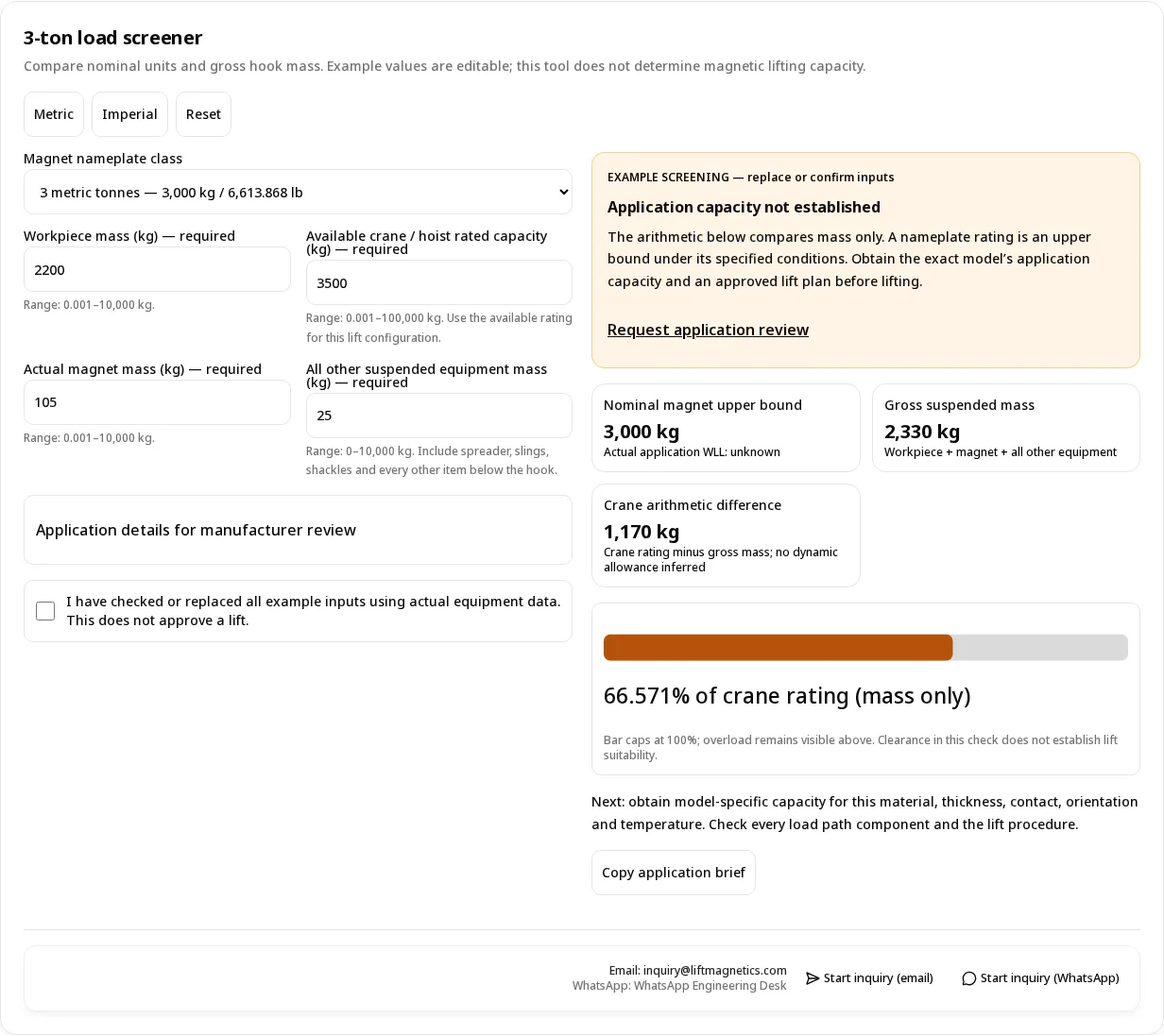
3-ton load screener
Compare nominal units and gross hook mass. Example values are editable; this tool does not determine magnetic lifting capacity.
What determines a useful 3-ton specification?
A 3-ton label starts the enquiry; it does not finish application selection. Keep these four decisions separate.
| Decision | What to establish | Evidence to use |
|---|---|---|
| Units | 3,000 kg and 6,000 lb are different nominal classes. | NIST unit definitions; actual nameplate. |
| Contact capacity | Thickness, shape and surface limits belong to the exact model. | KANETEC LPH and Eclipse examples below show separate application limits. |
| Crane load | Include every suspended attachment in the mass budget. | Entered masses; applicable crane manual and OSHA rated-load rule. |
| Permission to operate | Arithmetic and a product description cannot approve a lift. | Applicable instructions, inspection evidence and approved lift procedure; ASME scope. |
Sources: NIST Handbook 44 (2026), Appendix C; KANETEC LPH manufacturer specifications; OSHA 29 CFR 1910.179; ASME B30.20-2025 official scope.
1. Resolve metric tonnes and US short tons
Use the units written on the equipment. Do not silently convert “3 ton” into a 3,000 kg rating.
| Selected label | Mass in kg | Mass in lb |
|---|---|---|
| 3 metric tonnes | 3,000 | 6,613.868 (rounded) |
| 3 US short tons | 2,721.554 (rounded) | 6,000 |
| Difference | 278.446 | 613.868 |
- Read nameplate units
- Convert mass once
- Check application limits
2. Compare technology by the operating task
The following is an editorial selection framework, not a performance specification. Request the chosen model’s control description, duty rating and failure response before treating architectures as interchangeable.
| Architecture | Candidate task to discuss | Trade-off / evidence required |
|---|---|---|
| Manual permanent (PML) | Accessible, individual ferrous parts. | Check handle access, lock operation and application capacity; avoid assuming a standard lever force. |
| Electro-permanent (EPM) | Remote switching or an integrated handling cell. | Confirm switching supply, indication, interlocks, installed mass and loss-of-power recovery. A technology name is not a safety guarantee. |
| Battery-powered | Handling where a travelling supply cable is inconvenient. | Identify whether power sustains attraction or only changes magnetic state. Include charger, battery service and alarms in the purchase review. |
| Continuously energised electromagnet | Discuss scrap handling or other duty-specific systems. | Require the actual duty / temperature rating and power-loss protection. Bulk scrap capability cannot be inferred from a plate-lifting label. |
- Describe lift cycle
- Identify hold mechanism
- Verify failure response
Product examples: Eclipse Magnetics Ultralift Plus technical data; KANETEC battery lifting magnet catalogue, pp. 95–96. The catalogue examples do not establish a universal 3-ton specification.
3. Thickness, surface gaps and usable contact
Do not apply a universal 75 mm saturation threshold, exponential gap curve or multiplied percentage factors. Public data from another model does not establish the capacity of the lifter being purchased.
| Contact question | Send to the supplier | Leave unresolved until confirmed |
|---|---|---|
| Plate thickness | Minimum actual section under every pole; full part dimensions. | The applicable thickness curve and allowable load. |
| Paint, scale or rust | Condition photos and coating / gap measurements. | Capacity for that contact condition; cleaning and acceptance procedure. |
| Warp or uneven contact | Flatness and the area that can actually contact the poles. | Whether the selected pole arrangement can be used at all. |
| Material variability | Grade, heat treatment and mixed production batches. | Whether the published capacity data covers all intended parts. |
- Measure actual part
- Match model data
- Resolve missing limits
4. Handle access, lock operation and release
KANETEC notes that thin material and clearance can make handle operation harder. Eclipse describes a handle lock and lifting-eye interlock for its own range. Follow the selected model’s instructions; do not extrapolate a 35–50 kgf lever force to all 3-ton lifters.
Avoid carrying a suspended load over people. For the application review, show where the operator stands during engagement, travel and release. Ask for a demonstration using the intended workpiece and approved procedure. If access requires reaching into a trapping point, have the handling arrangement reconsidered before procurement.
- Reach controls
- Verify lock indication
- Release on support
KANETEC LPH manufacturer specifications; Eclipse Magnetics Ultralift Plus technical data.
5. Standards, test evidence and what remains unknown
| Reference | What the public source supports | What to obtain for your lift |
|---|---|---|
| ASME B30.20-2025 | Scope includes marking, inspection, testing, maintenance and operation of below-the-hook devices. | Applicable edition / provisions and identified equipment records; the public overview is not a compliance assessment. |
| OSHA 1910.179 | Where applicable, crane rated-load and movement rules. | Site applicability, crane instructions and the responsible person’s operating procedure. |
| Manufacturer safety-factor statement | KANETEC LPH publishes lifting capacity as one third of maximum holding power for that range. | The selected model’s stated test basis, conditions and records. Do not transfer the ratio to unrelated products. |
| European or other local requirements | Not assessed by this page. | Applicable local rules, declaration and operating / inspection requirements from the responsible supplier or qualified person. |
A 3:1 test statement is not spare operating capacity. This page does not infer a 9,000 kgf proof requirement, annual proof interval, universal pole-flatness limit or a friction-based vertical rating from the ASME overview.
- Identify equipment
- Obtain applicable records
- Approve lift procedure
ASME B30.20-2025 official scope; OSHA 29 CFR 1910.179; KANETEC LPH manufacturer specifications.
6. Material identification is a capacity input
Record the steel grade and its heat-treatment condition. Treat an unknown alloy as an unresolved input, rather than assigning a generic mild-steel percentage. For 304 / 316 austenitic stainless applications this screener issues a stop condition and directs the user to a verified handling method.
The review request should identify any later process sensitive to residual magnetism. Ask the supplier to agree a measurable acceptance criterion for that process; this page does not promise a residual Gauss value or claim a universal AWS threshold.
The need for material-specific application data is illustrated by KANETEC LPH manufacturer specifications. The process acceptance recommendation is an editorial review action.
7. Flat, round, pipe and tilting lifts are separate applications
| Named model / source | Flat rating | Round rating | Decision implication |
|---|---|---|---|
| KANETEC LPH-2000 | 2,000 kg | 900 kg | Separate ratings; diameter, length and contact limits still apply. |
| Eclipse UL4400+ (US table) | 4,400 lb | 1,760 lb | Round rating is 40% in this particular table, not a universal percentage. |
| Your 3-ton model | Unknown until identified | Unknown until identified | Request the exact chart, including pipe wall and diameter where applicable. |
These two published examples yield different round-to-flat ratios (45% and 40%). That is evidence against a generic 35% round or 25% pipe calculation. Vertical and tilting work is outside this tool: have a purpose-designed magnet, clamp or other handling system assessed for the full motion.
KANETEC LPH manufacturer specifications; Eclipse Magnetics Ultralift Plus technical data. Values are supplier-published specifications, not independent tests by LiftMagnetics.
8. Long plates and multiple lifting points
Provide length, width, thickness, centre of gravity and the proposed attachment positions. A larger nominal magnet does not answer whether the plate can deflect or lose pole contact during travel.
Do not simply divide total mass by the number of magnets. Ask the designer to establish load distribution, beam and sling ratings, contact retention and the consequences of unequal support. No universal “Airy point” spacing is specified here.
- Part & centre of gravity
- Attachment arrangement
- Complete load path
Model-specific dimensional limits are illustrated by KANETEC LPH manufacturer specifications. The arrangement checklist is an editorial request for design review.
9. Temperature, duty cycle and motion
Measure both the workpiece and operating environment. Obtain the complete equipment’s temperature and duty limits; specifying a high-temperature magnetic core alone does not rate the seals, bearings, electronics or assembled lifting device.
For powered equipment, request the rated operating cycle, charging / supply requirements and response to alarms. The KANETEC battery catalogue provides model-specific examples. It does not establish one battery lockout voltage, switching time or percentage of thermal capacity loss for every design.
- Measure environment
- Read duty / heat limits
- Resolve alarms & recovery
OSHA’s crane movement provisions, where applicable, address sudden acceleration and deceleration. A VFD setting does not increase a marked rating or resolve an unverified contact condition.
KANETEC battery lifting magnet catalogue, pp. 95–96; OSHA 29 CFR 1910.179.
10. Calculate the complete suspended mass
Gross suspended mass = workpiece + magnet + all other suspended equipment
For the tool’s example: 2,200 + 105 + 25 = 2,330 kg. Against an entered 3,500 kg crane limit the arithmetic difference is 1,170 kg. These are example masses, not specifications for a PML, EPM or battery model.
Use the available crane / hoist capacity for the actual configuration. Include every attachment below the hook once, including spreaders and adapters. Separately check shackles, slings, beams, connections, geometry and the crane manufacturer’s load definition.
- Workpiece + attachments
- Compare crane rating
- Verify every component
11. Worked screening examples and practical alternatives
Illustrative calculations and decision paths only; these are not customer lift records. All equipment masses below are assumed for the example.
| Assumptions | Process / result | Remaining action |
|---|---|---|
| 2,200 kg plate; 105 kg magnet; 25 kg rigging; 3,500 kg crane. | Gross 2,330 kg; difference +1,170 kg. | No crane mass exceedance shown. Obtain application WLL and lift approval. |
| 3,000 kg plate; 105 kg magnet; 25 kg rigging; 3,000 kg crane. | Gross 3,130 kg; crane exceeded by 130 kg. | Stop. Select a verified arrangement within all equipment ratings. |
| 3,000 kg plate; magnet marked 3 US short tons. | 3,000 − 2,721.554 = 278.446 kg above nominal magnet class. | Stop. Correct equipment selection; a clean surface cannot resolve nominal overload. |
| 400 kg pipe or a plate to be tilted vertically. | Mass alone cannot establish contact or orientation capacity. | Request a purpose-rated system. Compare a pipe-rated magnet, designed clamp or other verified alternative. |
| Risk | Review / mitigation | Cost or alternative to assess |
|---|---|---|
| Misuse: treating a nominal class as actual WLL. | Require a chart covering the exact part and procedure. | Avoid buying an oversized magnet without resolving contact. |
| Scenario mismatch: thin, curved, coated or tilting parts. | Verify the full handling cycle; reject unsupported uses. | Assess dedicated poles, distributed handling or another lifting method. |
| Operating cost omitted from comparison. | Request installed mass, power / charging, maintenance and training scope. | Compare total installed and service cost; no unverified price benchmark is quoted. |
| Inspection or spares unavailable. | Obtain identified instructions and service support before ordering. | Include downtime, replacement parts and competent inspection in the quote review. |
The risk table is an editorial procurement checklist. Alternative equipment must be assessed for the workpiece and site; it is not automatically suitable.
12. Questions before choosing a 3-ton lifting magnet
Capacity and units
Is a 3 ton lifting magnet always rated for 3,000 kg?
No. Three metric tonnes means 3,000 kg; three US short tons means 6,000 lb (2,721.554 kg). Confirm the units and application conditions on the exact nameplate and manual.
Can this calculator tell me the safe working load?
No. It converts the selected nominal class and adds suspended masses. Actual application WLL remains unknown until the exact model’s capacity data covers the workpiece and lift conditions.
Can I use a breakaway test force as a lifting rating?
No. A test holding force is not permission to lift that mass. Use the manufacturer’s marked rating, application limits and approved procedure.
Does a positive crane difference mean the lift can proceed?
No. It only means the entered static mass is below the entered crane rating. Magnetic capacity, every component rating, load balance and operating conditions still require verification.
Workpiece and contact
How thick must the steel be for a 3-ton magnet?
There is no universal minimum thickness for every 3-ton design. Obtain the model-specific thickness and contact data, including material, width and length limits. This page does not apply a generic saturation curve.
Can I apply the flat plate rating to a pipe?
No. Request a separate round or pipe rating covering outside diameter, wall thickness, length and pole contact. A generic 25% or 35% multiplier cannot establish capacity.
Can I lift several stacked sheets at once?
Do not infer multi-sheet capability from a single-sheet rating. Request equipment and a procedure specifically verified for the stack, including separation and retention risks.
Can I use the magnet to turn a plate upright?
This screener does not cover vertical or tilting lifts. Use a purpose-designed system and an application-specific procedure; it does not assign a friction-based reduced WLL.
Technology and operation
Does battery-powered mean electro-permanent?
No. Battery is a power-source description. Ask whether the battery sustains the magnetic field or only switches a permanent magnetic circuit, and obtain the documented low-battery and power-loss response.
Is an EPM system automatically safe during a blackout?
A permanent magnetic circuit can retain magnetisation without continuous field power, but that alone does not establish system safety. Verify the selected equipment’s control, indication, retention and recovery procedure.
Can I enter a universal temperature derating?
No. Compare measured workpiece and ambient temperatures with the exact lifter’s specified limits. Core material alone does not establish the whole assembly’s temperature rating.
Can a VFD drive compensate for an overloaded magnet?
No. Smooth motion does not increase a marked rating or establish magnetic capacity. Review acceleration, stopping and the complete lifting arrangement with the responsible qualified person.
Evidence and next steps
What inspection or proof test interval applies?
Use the manufacturer instructions, applicable rules and the responsible person’s inspection programme. This page does not prescribe an annual breakaway test or a universal pole-flatness tolerance.
What if the manual or application curve is unavailable?
Keep the lift on hold. Request the identified model’s manual and application data, or have a qualified person select an alternative handling system. Do not substitute a different brand’s chart.
What should I send for an application review?
Send model and serial number if available, actual masses, material, thickness, width or diameter, length, contact photos, temperature, lift orientation, crane rating and the intended lift path. The tool exports an initial brief.
Can I get a commercial quote from this page?
Yes. Use the review links with your application brief. For purchasing terms use the linked for-sale guide; for supplier qualification use the manufacturer guide.
13. Sources, method and evidence limits
Reviewed . Unit conversions use 1 lb = 0.45359237 kg. The calculator adds entered masses and compares them with nominal magnet and crane ratings; it does not simulate magnetic flux or infer capacity curves.
Published . Editorial owner: LiftMagnetics. Next review due , or sooner if sources or equipment requirements change.Send a source correction or application question.
- NIST Handbook 44 (2026), Appendix C
Unit definitions and conversions; not a lifting capacity source.
- KANETEC LPH manufacturer specifications
Model-specific flat / round ratings, dimensional limits and handle precautions. Listed models are examples, not a 3-ton product certification.
- Eclipse Magnetics Ultralift Plus technical data
Published flat / round ratings and product-specific safety features. Does not validate another model or a generic 3-ton curve.
- KANETEC battery lifting magnet catalogue, pp. 95–96
Battery equipment examples, duty and charging details. Battery architecture and power-loss behaviour must be confirmed per model.
- ASME B30.20-2025 official scope
Below-the-hook device marking, construction, inspection, testing, maintenance and operation. Public scope does not establish clause-level compliance or a universal test multiplier.
- OSHA 29 CFR 1910.179
US overhead / gantry crane rules, including rated load and movement precautions; applicability depends on the installation.
Manufacturer specifications are first-party examples, not independent validation. No identified 3-ton model, certified application curves or test certificate is supplied here. The tool therefore leaves actual application WLL unknown. Qualitative technology comparisons and review checklists are editorial guidance; obtain supplier confirmation for the selected system.
Prepare an application review
Copy the screener’s brief and add the model / serial number, full drawings, width or diameter, centre of gravity, contact photos, lift path, cycle and inspection documents. Ask for written confirmation of the permitted application and outstanding limitations. If equipment details are unavailable, request help selecting a verified handling method.