
3 Ton Lifting Magnet Supplier: Evidence & RFQ
Build a supplier brief, check nominal mass and identify missing evidence before comparing quotes.
Published · Reviewed · LiftMagnetics editorial team · Supplier-published guidance; application WLL remains unverified.
Supplier RFQ builder
Example load values are prefilled. Tare, crane rating and vendor evidence start unknown. Results update immediately on this device.
Range: greater than 0 to 8,000 kg.
Application and supplier requirements
Range: greater than 0 to 500 mm.
Range: greater than 0 to 16,000 mm.
Range: greater than 0 to 5,000 kg. Blank stays unknown.
Range: greater than 0 to 100,000 kg. Blank stays unknown.
Changing technology never overwrites your entered tare. Obtain actual mass for the selected configuration. Delivery choices express requirements, not availability promises.
Optional five-year cost planner (USD)
Use itemized quotes. Enter explicit zeros for included costs; blanks remain unknown. Price alone cannot establish supplier quality or legitimacy.
0–10,000,000 USD; blank means unknown.
0–10,000,000 USD; blank means unknown.
0–10,000,000 USD; blank means unknown.
0–10,000,000 USD; blank means unknown.
Equipment + landed extras + setup + 5 × annual allowance. Excludes financing, downtime, replacements, inflation and resale.
View RFQ text / manual copy
1. Key decisions before you shortlist a supplier
This is a procurement workflow, not a vetted vendor directory. Supplier names, stock, prices and conformity are not independently verified here. The following buying recommendations are editorial guidance; the linked sources establish their technical boundaries.
Swipe the table to compare all columns →
| Decision | Why it matters | Evidence / next action |
|---|---|---|
| Specify exact mass units | 3,000 kg and 6,000 lb differ by 278.45 kg. | NIST Handbook 44 (2026), Appendix C |
| Obtain application capacity | Nominal class does not cover every workpiece. | Industrial Magnetics FX use and maintenance manual |
| Check complete suspended mass | Lifter and rigging consume crane capacity. | OSHA 29 CFR 1910.179 |
| Compare equal delivered scope | A lower unit price can omit freight or service. | Editorial purchasing method: itemize the quote; do not infer quality from price. |
2. Choose a sourcing channel by responsibility
Swipe the table to compare all columns →
| Channel | Potential advantage | What to verify | Tradeoff |
|---|---|---|---|
| Direct manufacturer | Access to design and test ownership | Actual factory identity, application engineer and export support | Buyer may coordinate imports and local service. |
| Stocking distributor | Local stock and after-sales access | Exact model/serial availability, OEM authorization and service capability | Additional margin may buy logistics and support; quantify it. |
| Catalog / MRO reseller | Purchasing convenience | OEM identity, complete documents and technical escalation route | A catalog entry may not resolve a difficult application. |
These are editorial channel comparisons. No universal price premium, dispatch window or certificate quality is assigned to a channel.
3. Seven evidence areas for supplier review
Swipe the table to compare all columns →
| Area | Ask for | Hold / escalation trigger |
|---|---|---|
| 1. Product identity | OEM, exact model, rated-load units and matching delivered identification | Nameplate and offer disagree. |
| 2. Application and test evidence | Actual load conditions, application WLL, model curves and relevant test records | Only a nominal pull-force number is supplied. |
| 3. Controls and holding principle | Interlocks, operating sequence, power-loss behavior and limitations | A battery or remote-control label is treated as proof of retention. |
| 4. Lifting connection and traceability | Connection rating, markings, compatibility and applicable inspection records | Missing IDs or an unapproved substitute connection. |
| 5. Destination conformity | Applicable legislation, standards edition, declarations and instructions | Generic CE/ISO logos replace model-specific documentation. |
| 6. Service and inspection | Inspection intervals, removal criteria, authorized repairs and priced spares | No accountable service contact or repair procedure. |
| 7. Commercial delivery | Itemized price, named delivery term/place, stock evidence and warranty exclusions | Unclear importer, freight, acceptance or payment responsibilities. |
This checklist is an editorial purchasing aid. It is not a regulatory scoring system. Safety evidence is a prerequisite rather than points that other commercial benefits can offset.
4. Read the test record without turning it into lift approval
ASME publishes B30.20 for below-the-hook devices, including marking, inspection, testing and operation. Its public overview does not substantiate a specific test clause or universal annual test mandate. Ask the supplier and qualified reviewer to identify the applicable edition, technology-specific requirements and actual procedure. ASME B30.20-2025 — publisher overview
Swipe the table to compare all columns →
| Nominal class | If a 3:1 manual-permanent benchmark is specified | Boundary |
|---|---|---|
| 3 metric tonnes = 3,000 kg | 9,000 kgf ≈ 19,841.60 lbf | Force benchmark, not extra lifting capacity. |
| 3 US short tons = 6,000 lb | 18,000 lbf ≈ 8,164.66 kgf | Do not substitute the metric class. |
| EPM, battery system or DC electromagnet | Pending technology-specific confirmation | Do not apply the manual-permanent example automatically. |
These are transparent arithmetic examples, not certified minimums or instructions to proof test on site. Request model/serial, test geometry, material, surface, force, equipment ID, calibration traceability, date and responsible issuer. Distinguish breakaway characterization from other proof/load tests. A calibration record alone does not certify the finished product. ISO/IEC 17025:2017 — laboratory competence
5. Application limits that a supplier must resolve
Swipe the table to compare all columns →
| Input / condition | Known direction of risk | What remains unknown |
|---|---|---|
| Paint, scale, rust or pitting | Poor contact / air gaps can reduce force. | Usable WLL for the exact model and actual surface. |
| Thin or flexible plate | Flux path and deflection can change holding. | Minimum thickness, support arrangement and stable load limits. |
| Alloy, cast iron or elevated temperature | Material response and thermal limits vary. | Model-specific allowance and operating limit. |
| Round, hollow, vertical or irregular work | Contact geometry and load direction change. | Suitable device, tested capacity, center of gravity and support. |
The Industrial Magnetics manual illustrates these dependencies for its FX family. Its percentages and tables cannot be transferred to an unrelated lifter. This page does not calculate a numerical surface efficiency or reduced WLL. Industrial Magnetics FX use and maintenance manual
For a 304/316 load, do not procure a standard magnetic lifter from a nominal capacity claim. Seek a qualified review of rated mechanical or vacuum alternatives. Share width, temperature, orientation, center of gravity and duty cycle as well as the dimensions entered above.
6. Traceability and destination documents
Match supplied hardware and identification to the applicable inspection records. Request EN 10204 Type 3.1 documentation when the project specification or applicable requirements call for it; this page does not claim every shackle universally requires that document. A magnet-core grade such as N45/N50 alone does not prove assembled capacity.
For EU supply, confirm the placing-on-market date: Regulation (EU) 2023/1230 generally applies from 20 January 2027, with some provisions earlier. Obtain the responsible manufacturer/importer’s conformity assessment for the actual date and product; a generic logo is insufficient. European Commission — machinery legislation
7. Compare quote scope before comparing price
There is no verified universal bill of materials, magnet-core mass or minimum factory cost behind this page. A low quote is a reason to investigate scope and evidence, not proof of fraud. No current market price or live stock feed is provided.
Swipe the table to compare all columns →
| Quote line | Compare on the same basis | Ask when omitted |
|---|---|---|
| Device and controls | Exact model, application capacity, included accessories and power/control equipment | Is the quoted configuration complete? |
| Testing and documents | Applicable method, scope, model/serial coverage and document delivery | Are required records included before dispatch? |
| Delivery | Named Incoterm/place, freight, insurance, taxes and importer role | Who pays which charge and handles clearance? |
| Service | Commissioning, training, inspection support, parts and warranty exclusions | Which services cost extra and who performs them locally? |
8. Five-year planning subtotal with explicit unknowns
The optional planner uses your figures: equipment + landed extras + setup + 5 × annual inspection/service/energy allowance. Every line needs a value; enter zero only for a known included or inapplicable cost. Avoid double counting freight already included in a delivered quote.
Worked arithmetic example, not market pricing: $2,000 equipment + $500 landed extras + $300 setup + 5 × $200 annual allowance = $3,800. Financing, downtime, replacement parts outside the allowance, inflation and resale are excluded. Compare those separately when they affect the purchase decision.
9. Freight, packaging and customs without assumed clearance
For 2026, IATA identifies its DGR as the 67th edition. A changes summary cannot establish a particular lifter’s shipping classification. Ask a competent freight specialist to assess the packed device, any batteries, current packing rules and carrier variations, and confirm acceptance before booking. No universal gauss threshold or shielding thickness is supplied here. IATA — significant changes, 67th edition (2026)
For regulated raw-wood packaging, verify destination phytosanitary requirements and ISPM 15 treatment/marking. Fully processed wood materials can be exempt; not every crate requires the same treatment. Ask a customs broker for the exact device’s classification, duty and tax treatment rather than inferring an HS code from “3 ton.” IPPC — ISPM 15 wood-packaging standard
10. Hold purchase release when evidence conflicts
Escalate mismatched model/serial records, unclear application WLL, substituted lifting connections, unexplained document edits or undefined power-loss behavior. Assign an owner and a response date to every gap. If the supplier cannot resolve a critical gap, obtain an alternative engineered handling proposal before committing to equipment.
11. Contract for inspection and service
Request the manufacturer’s frequent/periodic inspection schedule, removal criteria, authorized repairs and retesting requirements, together with applicable site rules. This page does not prescribe an annual pull test, universal pole-flatness limit or field-strength threshold. Do not machine or regrind pole faces without an approved procedure.
Name the service provider and obtain written part numbers, prices, availability and dispatch commitments. A requested 48-hour SLA is a commercial requirement to negotiate, not an assumed industry guarantee. Clarify consumables, freight, travel charges, calibration access and warranty exclusions before release. ASME B30.20-2025 — publisher overview
12. From RFQ to receiving and commissioning
Send the brief and load drawings; resolve technical and commercial gaps; approve the documented configuration; verify the received serial/model, physical condition and records; complete the site’s qualified commissioning and operator training. A supplier’s dispatch estimate is separate from transit, customs and site readiness.
13. Worked procurement scenarios — hypothetical, not customer results
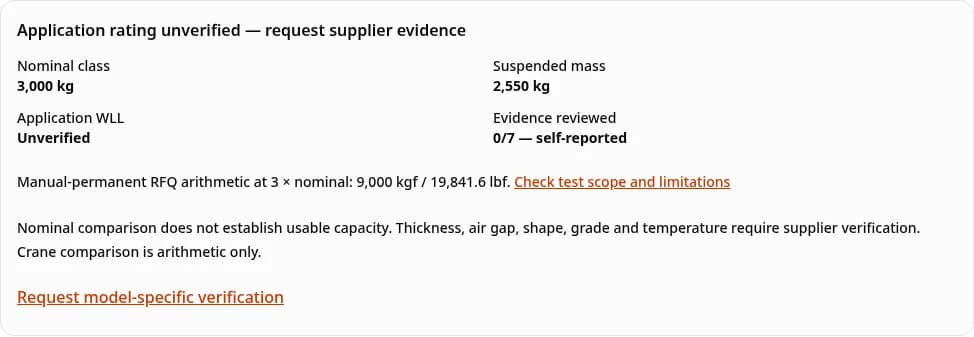
Urgent clean slab
Premise: Assume 2,400 kg, verified lifter/rigging 150 kg and a 3,000 kg crane in the stated configuration.
Decision: Hook arithmetic gives 2,550 kg (85%). Application WLL remains unknown. Request surface/thickness evidence, the exact stock unit and a written arrival commitment.
US capacity mismatch
Premise: Assume a 3,000 kg workpiece and an offer marked 3 US short tons.
Decision: The offered nominal class is 2,721.55 kg, below the load. Hold that offer and ask for a suitable engineered selection; freight speed does not resolve overload.
Painted hollow tube
Premise: Assume a 1,800 kg hollow tube with coating and no model-specific capacity evidence.
Decision: Weight below the nominal class is inconclusive. Request wall thickness, diameter/contact and coating evidence, or seek an engineered alternative. No numerical derating is guessed.
14. Supplier, capacity and service FAQ
Sourcing
Does this page list vetted or approved suppliers?
No. It provides a supplier evidence workflow and RFQ builder. No supplier list, live stock feed, certificate validation or independent vendor endorsement is provided.
Should I choose an OEM or distributor?
Choose the route that can document application suitability, delivery and support. An OEM may own design records; a stocking distributor may offer local inventory. Verify both claims in writing.
How long does procurement take?
No universal lead time is verified. Request exact model stock, allocation status, test/document completion dates, dispatch date and expected arrival. Separate custom engineering from shipping time.
Can a very low quote identify a fraudulent supplier?
Price alone cannot prove fraud, magnet metallurgy or test quality. Compare equal scope, identity, model-specific evidence, payment terms and delivery responsibilities; investigate unexplained differences.
Capacity
Are 3 metric tonnes and 3 US short tons interchangeable?
No. Three metric tonnes is 3,000 kg, approximately 6,613.87 lb. Three US short tons is 6,000 lb, approximately 2,721.55 kg. State the exact units and inspect the nameplate.
Does being below 3,000 kg mean a lift is acceptable?
No. Nominal class is only a comparison. Actual usable capacity depends on the exact lifter and workpiece conditions, with crane, rigging and site requirements checked separately.
Can I use a generic air-gap or thin-plate reduction percentage?
No. Request the selected model’s applicable curves and instructions. A different model’s percentage cannot validate your surface, thickness, grade, geometry or temperature.
Can a flat-plate rating be used for pipe or vertical lifting?
Do not transfer that rating. Round, hollow, vertical and irregular loads require an explicitly suitable device, application-specific capacity and an engineered handling arrangement.
Evidence
What does the 3:1 RFQ benchmark mean?
For the manual-permanent option, the tool illustrates three times the nominal mass as a force benchmark: 9,000 kgf for 3,000 kg, or 18,000 lbf for 6,000 lb. It does not verify a standard clause, prescribe a test or approve a lift. Other technologies require their own confirmation.
What should a test record identify?
Request the exact model/serial, rated-load units, test method and force, test conditions, equipment identity and calibration traceability, date and responsible issuer. Resolve differences against the actual application.
Does ISO/IEC 17025 prove that a supplier’s lifter is certified?
No. It concerns laboratory competence. Verify relevant accreditation scope and test-record traceability separately from product conformity, mechanical integrity and application suitability.
Does checking all seven boxes approve the supplier?
No. Boxes record buyer-reported document review only. Any unresolved safety gap remains a purchase hold, regardless of how many other documents are present.
Cost and logistics
How does the five-year planner handle missing costs?
A blank stays unknown. A subtotal appears only after all four lines have values, including explicit zeros. The subtotal excludes financing, downtime, replacements, inflation and resale.
Does a magnetic lifter automatically qualify for airfreight?
No. Ask a competent freight specialist to assess the packed unit, magnetic field, any batteries, current dangerous-goods rules and carrier acceptance. Generic shielding advice is not clearance.
Which customs code and duty rate should I use?
Do not infer these from the capacity label. Ask a customs broker to classify the exact device and confirm origin, destination, tax treatment and any trade measures before comparing delivered prices.
Service and conformity
Is annual proof testing or a universal wear limit assumed?
No. Obtain the exact model’s inspection intervals, removal criteria and authorized repair instructions, together with applicable site and jurisdiction requirements. Do not regrind poles or use a generic field-strength threshold from this page.
When does the EU Machinery Regulation apply?
Its general application date is 20 January 2027, with some provisions applying earlier. Have the responsible manufacturer/importer confirm the route for the actual placing-on-market date and destination.
What if JavaScript or clipboard access is unavailable?
Use the visible inquiry route and the application checklist in the report. With JavaScript enabled but clipboard blocked, the RFQ preview opens for manual copying.
15. Sources, method and evidence limits
Sources checked on 2026-11-09. Public publisher pages confirm their stated scope; full standards clauses were not independently verified here. Supplier declarations, inventory, price and application performance still require direct confirmation. Commercial checklists, comparisons and scenarios are editorial purchasing aids, not sourced market statistics.
Editorial review policy: recheck source editions, calculations and RFQ behavior by May 9, 2027, or sooner when requirements change. Rebuilding the site alone does not change the review date.
Mass-unit conversion reference. It does not establish a lifter’s application capacity.
Confirms standard scope and edition. Public overview does not verify individual clauses or a supplier’s compliance; request the applicable licensed text and model documentation.
US overhead/gantry crane requirements. Rated-load handling provisions support a complete suspended-load check; site applicability must be confirmed.
Manufacturer example explaining effects of contact surface, thickness, dimensions, steel composition and temperature. Its numeric tables apply to its specified models, not every 3-ton lifter.
Laboratory competence requirements. Laboratory accreditation and equipment calibration do not independently certify the finished lifter.
Regulation (EU) 2023/1230 generally applies from 20 January 2027, with some provisions applying earlier. Confirm the placing-on-market date and applicable conformity route.
Confirms the 2026 edition. This public changes summary is not the full dangerous-goods classification or packing instruction; a competent shipper must confirm packed-unit acceptance.
International phytosanitary framework for regulated wood packaging. Fully processed wood packaging has exemptions; verify destination requirements.
16. Request a model-specific supplier review
Copy the RFQ and send load drawings, surface photos, destination and required arrival date. If the tool is unavailable, send mass, length/width/thickness, geometry, steel grade, temperature, orientation, duty cycle, crane capacity and known rigging mass. Ask for written application suitability and an itemized offer before purchase release.